SRM Kattankulathur Dental College and Hospital, Kattankulathur
Ranked #19 by NIRF, NAAC A++ Accredited | Recognized by dental council of India


The NEET Formula 2026 Sheet is one of the most essential last-minute revision tools for aspirants preparing to maximise speed, accuracy, and formula recall before the exam. Covering high-weightage Physics and Chemistry formulas based on NEET previous year trends, this formula sheet PDF helps students rapidly revise key equations, strengthen conceptual recall, reduce exam-day confusion, and improve performance in numerical-based questions. Whether used for final NEET preparation or structured reNEET revision, this formula sheet serves as a strategic quick-revision guide for aspirants targeting a higher AIR.
This Story also Contains
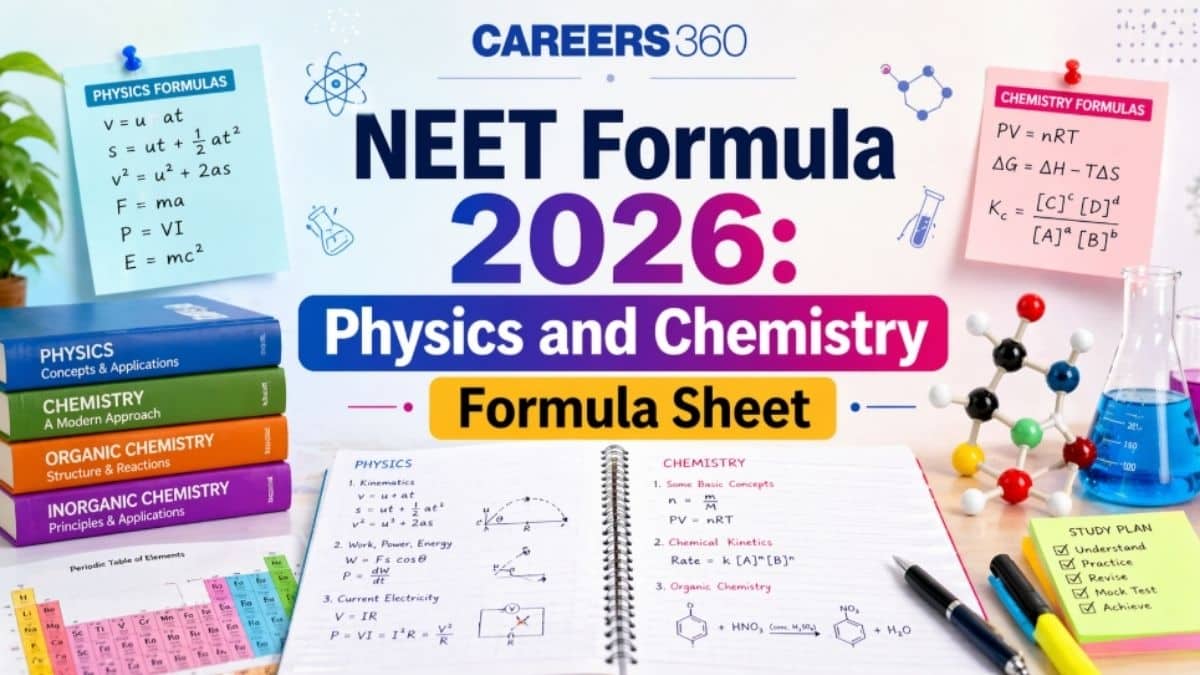
This complete NEET Formula 2026 resource includes the most important Physics and Chemistry formulas repeatedly asked across NEET previous year papers and mock trends. Regular formula revision strengthens active recall, improves speed in numerical solving, reduces conceptual confusion, and supports high-efficiency last-minute preparation. Designed as a strategic quick-revision companion, this formula sheet helps aspirants consolidate scoring concepts before NEET 2026 exam day.
To help aspirants revise quickly and effectively, we have provided a detailed NEET 2026 formula sheet PDF covering all important Physics and Chemistry formulas. Candidates can easily download the subject-wise formula sheets from the table below and use them for last-minute revision and concept strengthening.
Ranked #19 by NIRF, NAAC A++ Accredited | Recognized by dental council of India
Special Scholarship for Students from Goa (Get an exclusive scholarship of ₹20,000 if you're a Goa-based student) | Bringing Parul Education Trust's 30-year Education Legacy to Goa
|
NEET Formula Sheet 2026 |
Get expert advice on college selection, admission chances, and career path in a personalized counselling session.
With NEET preparation entering its most critical stage, aspirants need a quick-access, exam-focused formula resource rather than bulky notes. The NEET Formula Sheet PDF 2026 offers:
This makes it a strategic scoring asset, not just a formula list.
In the final revision phase, aspirants should focus on strengthening formula retention, minimising repeated errors, and improving rapid recall rather than exploring new concepts. A structured NEET formula revision plan allows students to sharpen accuracy, boost speed, and maximise performance in formula-intensive questions.
According to NEET toppers' strategy and structured revision experts, the final days before NEET should focus on formula retention, accuracy, and smart recall rather than new theory. Effective formula revision helps aspirants:
Daily revision of these important NEET formulas prevents confusion in expressions such as $R$ vs $R^2$, $\sin\theta$ vs $\sin^2\theta$
The formula sheet covers NEET high-weightage numerical chapters important for boosting exam scores.
Also, a clear understanding of all formulas helps in selecting high-accuracy question types quickly, differentiating between solvable questions and time-consuming ones.
Ranked among the top Dental Colleges for 7 consecutive years by India Today poll
Spend 60–90 minutes daily revising formula sheets alongside NEET PYQs and mock analysis for maximum score efficiency.
It increases the active recall of formulas during the NEET 2026 exam day.
The NEET 2026 Physics Formula Sheet includes all major high-weightage equations from Mechanics, Electrostatics, Current Electricity, Optics, Oscillations, and Modern Physics. These important physics formulas form the core of NEET numerical problem-solving and require repeated revision for stronger exam-day recall.
These formulas are repeatedly asked in NEET previous year papers and form the backbone of numerical problem-solving.
Based on NEET PYQ trends, the most formula-intensive and scoring Physics chapters include:
Repeated revision of these chapters significantly boosts numerical-solving confidence and score potential.
EMF & terminal voltage: $V = E - Ir$
Current in circuit: $I = \frac{E}{R + r}$
Potentiometer: $\frac{E_1}{E_2} = \frac{l_1}{l_2}$
Power (parallel): $P = \frac{V^2}{R}$
Power (series): $P = I^2 R$
n resistors in parallel: $R_{\text{eff}} = \frac{R}{n}$
Wheatstone bridge: $\frac{P}{Q} = \frac{R}{S}$
Drift velocity: $v_d = \frac{I}{neA} = \frac{eE\tau}{m}$
Current density: $J = \sigma E = \frac{E}{\rho} = ne v_d$
Coulomb’s law: $F = \frac{k q_1 q_2}{r^2}$
Potential: $V = \frac{kQ}{r}$
Dipole field: $E \propto \frac{1}{r^3}$
Dipole energy change: $\Delta U = pE(\cos\theta_1 - \cos\theta_2)$
Capacitance: $C = \frac{K \varepsilon_0 A}{d}$
Energy stored: $U = \frac{1}{2}CV^2 = \frac{Q^2}{2C}$
Charge sharing: $V' = \frac{V}{2}$
Lensmaker: $\frac{1}{f} = (n-1)\left(\frac{1}{R_1} - \frac{1}{R_2}\right)$
Power: $P = \frac{1}{f}$
Snell’s law: $n_1 \sin\theta_1 = n_2 \sin\theta_2$
Critical angle: $\sin C = \frac{n_2}{n_1}$
Mirror formula: $\frac{1}{v} + \frac{1}{u} = \frac{1}{f}$
Microscope: $M = \frac{L}{f_o}\left(1 + \frac{D}{f_e}\right)$
Telescope: $M = \frac{f_o}{f_e}$
YDSE: $\beta = \frac{\lambda D}{d}$
Brewster angle: $\tan \theta_B = n$
g with height: $g' = g\left(\frac{R}{R+h}\right)^2$
g with depth: $g' = g\left(1 - \frac{d}{R}\right)$
Kepler’s law: $T^2 \propto R^3$
Escape velocity: $v_e = \sqrt{2gR}$
Orbital velocity: $v_o = \sqrt{\frac{GM}{r}}$
Angular momentum: $I_1 \omega_1 = I_2 \omega_2$
Half-wave rectifier: $f_{\text{out}} = f_{\text{in}}$
Full-wave rectifier: $f_{\text{out}} = 2f_{\text{in}}$
Zener voltage: $V_{\text{out}} = V_Z$
Solenoid: $B = \mu_0 n I$
Radius in B: $r = \frac{mv}{qB}$
Torque: $\tau = nBIA \sin\theta$
Straight wire: $B = \frac{\mu_0 I}{2\pi r}$
Pendulum: $T = 2\pi \sqrt{\frac{l}{g}}$
Spring: $T = 2\pi \sqrt{\frac{m}{k}}$
Velocity: $v = \omega \sqrt{A^2 - x^2}$
RMS: $V_{\text{rms}} = \frac{V_0}{\sqrt{2}}$
Impedance: $Z = \sqrt{R^2 + (X_L - X_C)^2}$
Resonance: $\omega_0 = \frac{1}{\sqrt{LC}}$
Power: $P = V_{\text{rms}} I_{\text{rms}} \cos\phi$
Photoelectric: $KE_{\max} = h\nu - \phi$
de Broglie: $\lambda = \frac{h}{mv}$
Bohr radius: $r_n = n^2 \times 0.529 , \text{Å}$
Energy: $E_n = -\frac{13.6}{n^2}$
Nuclear radius: $R = R_0 A^{1/3}$
Decay: $N = N_0 e^{-\lambda t}$
nth second: $S_n = u + \frac{a}{2}(2n-1)$
Momentum: $\sum m u = \sum m v$
Projectile height: $H = \frac{u^2 \sin^2\theta}{2g}$
Terminal velocity: $v_t = \frac{2r^2 (\rho - \sigma) g}{9\eta}$
The NEET 2026 Chemistry Formula Sheet covers all essential formula-driven concepts from Physical Chemistry and selected high-weightage chemistry chapters, including Electrochemistry, Thermodynamics, Equilibrium, Solutions, and Chemical Kinetics. For last‑minute NEET 2026 preparation, this formula sheet serves as a reliable reference to maximise scoring potential in the Chemistry section. Ass this structured formula resource helps aspirants improve speed and reduce errors.
The highest-scoring formula-based Chemistry chapters include:
These chapters repeatedly contribute formula-driven questions and often determine speed-based Chemistry performance.
Cell potential: $E^\circ_{\text{cell}} = E^\circ_c - E^\circ_a$
Nernst: $E = E^\circ - \frac{0.0592}{n} \log Q$
Gibbs relation: $\Delta G^\circ = -nFE^\circ$
Kohlrausch: $\lambda^\circ_m = \sum \lambda^\circ_{\text{ions}}$
Degree dissociation: $\alpha = \frac{\lambda_m}{\lambda^\circ_m}$
Faraday: $W = \frac{M}{nF} It$
First order: $k = \frac{2.303}{t} \log \frac{[A]_0}{[A]}$
Half-life: $t_{1/2} = \frac{0.693}{k}$
Arrhenius: $\ln k = \ln A - \frac{E_a}{RT}$
Second order: $t_{1/2} = \frac{1}{k[A]_0}$
First law: $\Delta U = q + w$
Gibbs: $\Delta G = \Delta H - T\Delta S$
Equilibrium: $\Delta G^\circ = -RT \ln K$
$K_p$ relation: $K_p = K_c (RT)^{\Delta n}$
Heat capacity: $C_p - C_v = R$
pH: $\text{pH} = -\log [H^+]$
Salt pH: $\text{pH} = 7 + \frac{1}{2}(pK_a + \log c)$
Degree ionisation: $\alpha = \sqrt{\frac{K_a}{c}}$
Buffer: $\text{pH} = pK_a + \log \frac{[A^-]}{[HA]}$
Raoult: $p_A = x_A p^\circ_A$
Boiling rise: $\Delta T_b = K_b m$
Freezing drop: $\Delta T_f = K_f m$
Osmotic pressure: $\pi = CRT$
Van’t Hoff: $i = 1 + \alpha (n-1)$
Energy: $E_n = -\frac{13.6 Z^2}{n^2}$
Radius: $r_n = \frac{0.529 n^2}{Z}$
Wavelength: $\frac{1}{\lambda} = RZ^2 \left(\frac{1}{n_1^2} - \frac{1}{n_2^2}\right)$
Ideal gas: $PV = nRT$
Partial pressure: $P_A = x_A P_{\text{total}}$
Molar volume: $V = 22.4 , \text{L (STP)}$
Effective use of the NEET 2026 Formula Sheet requires a structured approach to revision. Aspirants should integrate the NEET formula sheet into their daily study routine to maximise recall and accuracy. It helps in solving:
Top 50 Physics numericals that score 120+ marks based on the most repeated physics concepts in PYQs.
Practice the top 75 repeated chemistry questions in NEET to cover the most scoring concepts.
Practising NEET Physics question paper PYQs to gain practice of the exam pattern.
To maximise results, aspirants should:
This structured approach transforms formula sheets into rank-improving tools.
Combine formula sheet revision with:
This hybrid revision system significantly improves formula retention and competitive score potential.
Frequently Asked Questions (FAQs)
It improves recall speed, strengthens weak areas, and helps decide which questions to attempt or skip.
Revise formulas daily, practise PYQs, and apply them in mock tests to build confidence and accuracy.
Mechanics, Electrostatics, Current Electricity, Oscillations, and Modern Physics are consistently asked in NEET previous year papers.
A chapter-wise formula sheet covering all high-weightage Physics and Chemistry formulas with PYQ relevance is ideal.
Yes, it is one of the most effective tools for final revision and rapid recall.

On Question asked by student community
Hi Asta,
NEET Chapter wise pyqs for Class 11 and 12th you can check from the below link.
https://medicine.careers360.com/articles/neet-pyq-chapterwise
Hope it works.
Hello Students,
For the NEET UG 2026 Question Paper PDF with Answer Key and Solutions, refer to the article below:
https://medicine.careers360.com/articles/neet-previous-year-question-paper-with-solution
Hello Student,
You can check the resource provided below:
Download NEET Previous 10 Years Question Papers with Solutions PDF
You can also check the NEET 2026 question paper with solutions
Hope this helps!
Hello Chetan,
Here are the links you asked for. I hope they serve your purpose.
Hello Suma,
Here are the links you asked for. I hope they serve your purpose.
the product 'P' will be ,


| Column A | Column B |
| A |
a) Organisation of cellular contents and further cell growth. |
| B |
b) Leads to formation of two daughter cells. |
| C |
c) Cell grows physically and increase volume proteins,organells. |
| D |
d) synthesis and replication of DNA. |
Match the correct option as per the process shown in the
0.16 g of dibasic acid required 25 ml of decinormal solution for complete neutralisation. The modecular weight of the acid will be
32
64
128
256
0xone is

Ranked #19 by NIRF, NAAC A++ Accredited | Recognized by dental council of India
Special Scholarship for Students from Goa (Get an exclusive scholarship of ₹20,000 if you're a Goa-based student) | Bringing Parul Education Trust's 30-year Education Legacy to Goa
Ranked among the top Dental Colleges for 7 consecutive years by India Today poll