SRM Kattankulathur Dental College and Hospital, Kattankulathur
Ranked #19 by NIRF, NAAC A++ Accredited | Recognized by dental council of India


High-Accuracy Question Types for NEET Toppers will be beneficial for aspirants of NEET 2027 to improve their speed, accuracy and question selection skills. It is important to prepare the entire syllabus of NEET; however, practising those question types that aspirants can solve without any difficulty will certainly reduce the number of silly mistakes and negative markings. NEET latest trends reveal that there is a good number of numerical and concept-based questions in Physics; in Chemistry NCERT based statement, facts and graphs, whereas Biology has a strong association with NCERT concepts, facts and diagrams.
This Story also Contains
.jpg)
For NEET 2027 preparation, it is important for students to practice different types of questions like NCERT-based MCQs, numerical questions based on formulas, statement-based questions, diagram-based questions, graph-based questions and match-the-column questions. This article discusses the question types for NEET exam toppers in Physics, Chemistry and Biology with some examples.
Each individual must be able to find his/her own types of high-accuracy questions by doing PYQs and test papers. A question that appears to be easy but often causes errors should not be taken as a high-accuracy question.
Get expert advice on college selection, admission chances, and career path in a personalized counselling session.
NEET 2027 Physics preparation needs conceptual clarity and speed. Toppers do not attempt to master all 28 NEET Physics chapters equally. They focus on high-weightage physics NEET chapters, scoring question types to near‑perfect accuracy. Toppers focus on:
High-weightage numerical chapters like Current Electricity, Electrostatics, Optics, and Modern Physics.
Top 50 Physics numericals that score 120+ marks based on the most repeated physics concepts in PYQs.
Revising all important physics formulas regularly.
Practising NEET Physics question paper PYQs to gain practice of the exam pattern.
Ranked #19 by NIRF, NAAC A++ Accredited | Recognized by dental council of India
Special Scholarship for Students from Goa (Get an exclusive scholarship of ₹20,000 if you're a Goa-based student) | Bringing Parul Education Trust's 30-year Education Legacy to Goa
1. Formula‑Based NEET Numericals
Most rewarding category in NEET Physics. It has direct substitution of formulas such as electric field calculation, lens power, terminal voltage, and Kepler’s third law.
Question:
A particle of mass $m$ is projected from the surface of Earth with velocity $v = kV_e$ $(k < 1)$, where $V_e$ is the escape velocity. The maximum height reached above the surface of Earth is:
Options:
(1) $\dfrac{Rk}{(1 - k)^2}$
(2) $\dfrac{Rk}{(1 + k)^2}$
(3) $\dfrac{Rk^2}{(1 + k)}$
(4) $\dfrac{Rk^2}{(1 - k^2)}$
Correct Answer: (4) $\dfrac{Rk^2}{(1 - k^2)}$
Explanation:
Using energy conservation:
Initial energy $= \dfrac{1}{2}mv^2 - \dfrac{GMm}{R}$
Final energy at max height $= -\dfrac{GMm}{R + h}$
So,
$\dfrac{1}{2}mv^2 = GMm\left(\dfrac{1}{R} - \dfrac{1}{R + h}\right)$
Substitute $v = k\sqrt{2gR}$:
$\dfrac{1}{2}m(2gRk^2) = GMm\left(\dfrac{1}{R} - \dfrac{1}{R + h}\right)$
Solving gives:
$h = \dfrac{Rk^2}{1 - k^2}$
2. Direct Conceptual NEET MCQs
It is the most reliable scoring zone from Units & Measurements, Electromagnetic Waves, and Semiconductor Electronics. It examines direct single NCERT facts or definitions.
Question:
Plane angle and solid angle have:
Options:
(1) Both units and dimensions
(2) Units but no dimensions
(3) Dimensions but no units
(4) No units and no dimensions
Correct Answer: (2) Units but no dimensions
Explanation:
Plane angle (radian) $= \dfrac{\text{arc}}{\text{radius}}$ → dimensionless
Solid angle (steradian) $= \dfrac{\text{area}}{r^2}$ → dimensionless
Thus, both are dimensionless quantities but have defined SI units (radian and steradian).
3. Graph-Identification NEET Questions
It is a commonly asked question in Kinematics, Oscillations, and Capacitor Discharge. These are highly predictable (example: v‑t graph of a ball in viscous liquid reaching terminal velocity)
Question:
A spherical ball is dropped in a long column of highly viscous liquid. Which curve represents speed $(v)$ as a function of time $(t)$?
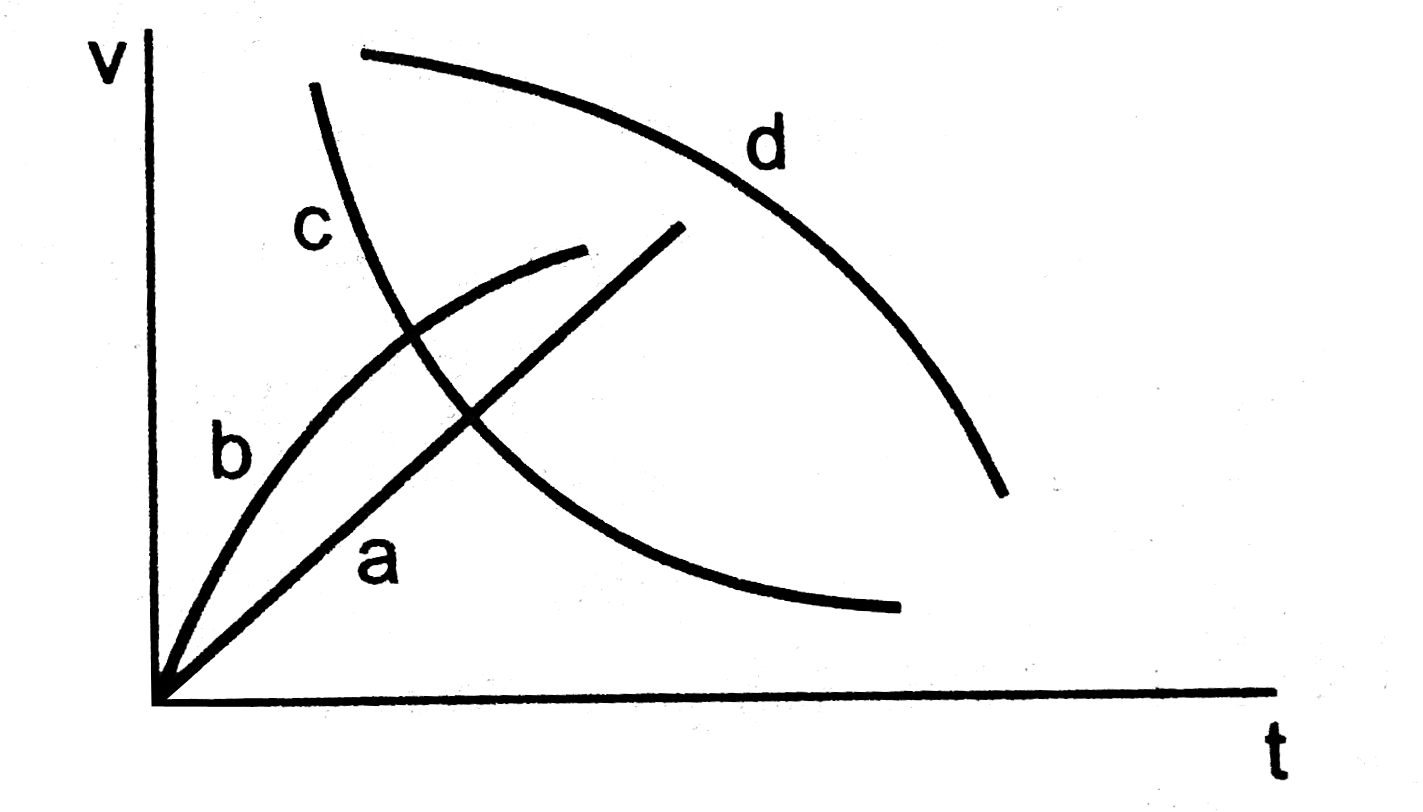
Options:
(1) a
(2) b
(3) c
(4) d
Correct Answer: (2) b
Explanation:
Initially, the ball accelerates due to gravity. As velocity increases, viscous drag and buoyant force increase. Eventually, drag + buoyancy = weight ⇒ net force becomes zero, and the ball attains terminal velocity.
Thus, speed increases initially and then becomes constant (the graph shows a rising curve that flattens).
4. Statement‑Based / Assertion‑Reason NEET Questions
These tests the conceptual clarity and logical reasoning rather than formula recall. Toppers treat them as high‑accuracy because the options are predictable once the concept is clear.
Question:
Statement I: Biot-Savart law gives magnetic field for an infinitesimal current element only.
Statement II: It is analogous to Coulomb's law with $I d\ell$ being the scalar source.
Options:
(1) Both correct; II explains I
(2) Both correct; II does not explain I
(3) I correct; II incorrect
(4) I incorrect; II correct
Correct Answer: (3) I correct; II incorrect
Explanation:
Statement I is correct — Biot-Savart law gives $dB$ due to an infinitesimal current element $I d\ell$. To find the total magnetic field, we integrate over the conductor.
Statement II is incorrect — $I d\ell$ is a vector quantity, whereas charge $q$ in Coulomb’s law is a scalar. Although there is an analogy between the laws, the nature of the source quantities is different.
5. NEET Diagram‑Based Physics Questions
These questions test whether aspirants can interpret circuit diagrams, waveforms, or graphical setups correctly under exam pressure.
Question:
A full wave rectifier circuit uses diodes $D_1$ and $D_2$. The input is $V_{in} = 220\sin(100\pi t)\ \text{V}$. At $t = 15\ \text{ms}$ the state of diodes is:
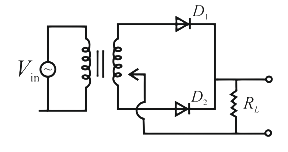
(1) $D_1$ forward biased $D_2$ reverse biased
(2) $D_1$ reverse biased $D_2$ forward biased
(3) Both forward biased
(4) Both reverse biased
Correct Answer: $D_1$ reverse biased $D_2$ forward biased
Explanation:
Put $t = 0.015\ \text{s}$ in the given expression.
$V = 220\sin(100\pi \times 0.015) = 220\sin(1.5\pi) = -220\ \text{V}$.
This is the negative half cycle of AC input.
So $D_2$ conducts while $D_1$ remains reverse biased.
NEET 2027 Chemistry Preparation needs a detailed NCERT revision. Toppers prioritise:
Inorganic NCERT factual MCQs (Periodic Table, Coordination Compounds) included in 25 must-do inorganic questions with solutions for NEET 2027.
Physical Chemistry numericals (Thermodynamics, Solutions, Chemical Kinetics).
Practice the top 75 repeated chemistry questions in NEET to cover the most scoring concepts.
Mater Organic Chemistry top 40 Organic Reactions and conversions based on PYQs analysis
1. Numerical Chemistry Questions
These are found mainly in physical chemistry chapters (Bohr model, Chemical Kinetics, Thermodynamics). It has a direct formula application with unit conversion.
Question:
The half-life of a first-order reaction is 1 minute. The time required for 99.9% completion is closest to:
Options:
(1) 2 minutes
(2) 4 minutes
(3) 5 minutes
(4) 10 minutes
Correct Answer: (4) 10 minutes
Explanation:
For a first-order reaction:
Number of half-lives required for 99.9% completion $\approx 10$
(since $\log 1000 = 3\log 10$)
Thus,
$t = 10 \times t_{1/2} = 10 \times 1 = 10,\text{minutes}$
2. Direct NCERT-Based NEET Questions
These are straight factual MCQs from the NCERT lines. It is common in Inorganic Chemistry and p‑Block elements.
Question:
Dalton's Atomic Theory could NOT explain which of the following?
Options:
(1) Law of conservation of mass
(2) Law of constant proportion
(3) Law of multiple proportions
(4) Law of gaseous volumes
Correct Answer: (4) Law of gaseous volumes
Explanation:
Dalton’s atomic theory successfully explains the laws of conservation of mass, constant proportion, and multiple proportion.
However, it could not explain Gay-Lussac's law of gaseous volumes, because Dalton did not consider the molecular (e.g., diatomic) nature of gases.
3. Statement‑Based Questions
Two statements are given, and these test correctness and explanation. It is common in Acid strength trends, drug classification, and bonding concepts.
Question :
Statement I: Aspirin and Paracetamol belong to the class of narcotic analgesics.
Statement II: Morphine and Heroin are non-narcotic analgesics.
Options:
(1) Both true
(2) Both false
(3) I correct; II incorrect
(4) I incorrect; II correct
Correct Answer: (2) Both false
Explanation:
Both statements are incorrect. Aspirin and Paracetamol are non-narcotic analgesics, while Morphine and Heroin are narcotic analgesics.
Question :
Statement I: Acid strength increases: $HF \ll HCl \ll HBr \ll HI$
Statement II: As size increases down the group, bond strength of $H\text{-}X$ decreases and acid strength increases.
Options:
(1) Both true
(2) Both false
(3) I correct; II incorrect
(4) I incorrect; II correct
Correct Answer: (1) Both true
Explanation:
Both statements are correct. As we move down the group, atomic size increases, bond strength of $H\text{-}X$ decreases, making ionization easier. Hence, acid strength increases in the order:
$HF < HCl < HBr < HI$.
4. Diagram‑Based Questions
These identify reactions or products using structural diagrams. Common in Organic Chemistry (Hinsberg test, functional groups).
Question:
Identify the compound that reacts with Hinsberg reagent to give a solid that dissolves in alkali.
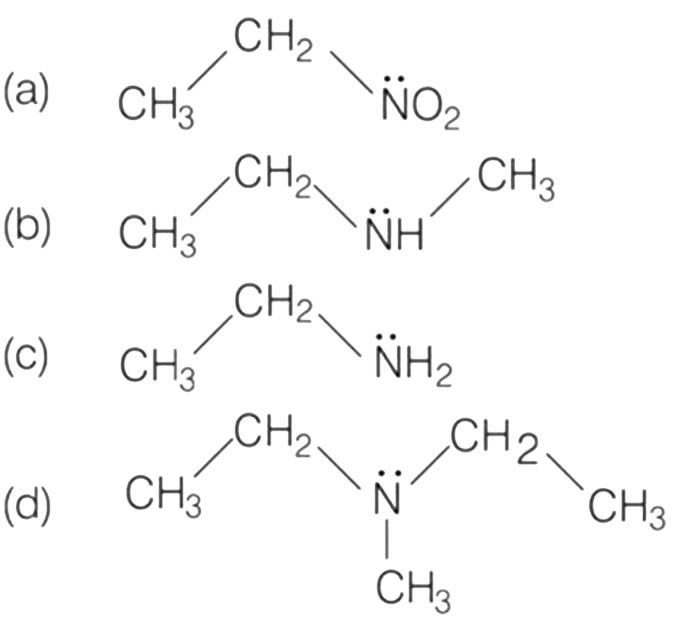
Correct Answer: (C) CH₃–NH₂ type (primary amine)
Explanation:
Primary amines react with Hinsberg’s reagent to form a sulphonamide containing an N–H bond, which is acidic and dissolves in alkali.
Secondary amines form sulphonamides without N–H, so they are insoluble in alkali.
Tertiary amines do not react with Hinsberg’s reagent.
5. Match List Questions
Match compounds with properties (magnetic moment, oxidation state, ligand field). Common in Coordination Compounds.
Question:
Match List-I (coordination compounds of Fe) with List-II (magnetic moments in BM):
|
List-I: |
List-II: |
|
(a) $[Fe(CN)_6]^{3-}$ |
(i) $0$ BM |
|
(b) $[Fe(H_2O)_6]^{3+}$ |
(ii) $5.92$ BM |
|
(c) $[Fe(CN)_6]^{4-}$ |
(iii) $4.90$ BM |
|
(d) $[Fe(H_2O)_6]^{2+}$ |
(iv) $1.73$ BM |
Options:
(1) a–iv, b–ii, c–i, d–iii
(2) a–ii, b–iv, c–iii, d–i
(3) a–i, b–iii, c–iv, d–ii
(4) a–iv, b–i, c–ii, d–iii
Correct Answer: (1) a–iv, b–ii, c–i, d–iii
Explanation:
$(a)\ [Fe(CN)_6]^{3-}$: Fe³⁺ (d⁵), strong field ligand → low spin → 1 unpaired → $1.73$ BM
$(b)\ [Fe(H_2O)_6]^{3+}$: Fe³⁺ (d⁵), weak field ligand → high spin → 5 unpaired → $5.92$ BM
$(c)\ [Fe(CN)_6]^{4-}$: Fe²⁺ (d⁶), strong field → low spin → 0 unpaired → $0$ BM
$(d)\ [Fe(H_2O)_6]^{2+}$: Fe²⁺ (d⁶), weak field → high spin → 4 unpaired → $4.90$ BM
Ranked among the top Dental Colleges for 7 consecutive years by India Today poll
The NEET Biology section carries the highest weightage (50%). Toppers' strategy is to complete biology in 45 minutes in the NEET exam. To achieve this, toppers focus on:
NCERT-based biology MCQs from Genetics, Human Physiology, and Ecology.
Important biology diagram‑based questions (Plant anatomy, Human systems).
Assertion‑Reason questions that test the conceptual clarity.
Practice the top 100 questions in biology to score 330+ based on PYQs.
1. Direct NCERT Biology Questions
Question:
A typical angiosperm embryo sac at maturity is:
Options:
(1) 8-nucleate and 7-celled
(2) 7-nucleate and 8-celled
(3) 7-nucleate and 7-celled
(4) 8-nucleate and 8-celled
Correct Answer: (1) 8-nucleate and 7-celled
Explanation:
6 cells (egg + synergids + antipodals) + 1 central cell = 7 cells.
Central cell has 2 nuclei → total 8 nuclei.
Question:
Which one of the following is an example of ex-situ conservation?
Options:
(1) National park
(2) Wildlife sanctuary
(3) Zoos and botanical gardens
(4) Protected areas
Correct Answer: (3) Zoos and botanical gardens
Explanation:
Ex-situ = conservation outside natural habitat.
Zoos and botanical gardens maintain species externally.
Question:
Which type of immunity is present at the time of birth and is non-specific?
Options:
(1) Acquired Immunity
(2) Innate Immunity
(3) Cell-mediated Immunity
(4) Humoral Immunity
Correct Answer: (2) Innate Immunity
Explanation:
Innate immunity is present at birth.
It provides immediate, non-specific defence.
2. Statement‑Based Questions
Question:
During muscular contraction, which of the following events occur?
a) H zone disappears
b) A band widens
c) I band reduces
d) Myosin hydrolyses ATP
e) Z lines pulled inward
Options:
(1) a, c, d, e only
(2) a, b, c, d only
(3) b, c, d, e only
(4) b, d, e, a only
Correct Answer: (1) a, c, d, e only
Explanation:
H-zone disappears and I-band shortens during contraction.
A-band remains constant (does NOT widen).
Z-lines move closer and myosin hydrolyses ATP for contraction.
3. Assertion‑Reason Biology Questions
Question:
Assertion (A): All vertebrates are chordates but all chordates are not vertebrates.
Reason (R): Members of subphylum Vertebrata possess a notochord during the embryonic period; it is replaced by a vertebral column in adults.
Options:
(1) Both A and R true; R explains A
(2) Both A and R true; R does not explain A
(3) A true; R false
(4) A false; R true
Correct Answer: (1) Both A and R true; R explains A
Explanation:
All vertebrates show chordate features → hence are chordates.
Some chordates lack vertebral column (e.g., non-vertebrates).
Vertebrates have notochord replaced by vertebral column → explains classification.
4. Match List-Based Questions
Question:
Match List I with List II:
|
List I |
List II |
|
A. Cilium |
I. 9+2 |
|
B. Flagellum |
II. 9+2 |
|
C. Centriole |
III. 9+0 |
|
D. Basal body |
IV. 9+0 |
(1) A-I, B-II, C-III, D-IV
(2) A-II, B-I, C-IV, D-III
(3) A-III, B-IV, C-I, D-II
(4) A-I, B-III, C-II, D-IV
Correct Answer: (1)
Explanation: Cilia and flagella have $9+2$ arrangement; centriole and basal body have $9+0$ arrangement.
5. Diagram‑Based Biology Questions
Question:
Identify the part of a bioreactor used as a foam breaker from the given figure
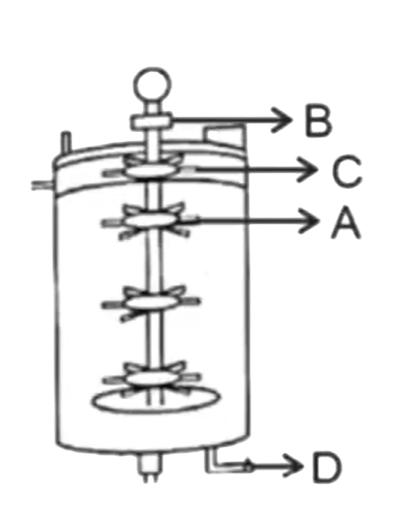
Options:
(1) A
(2) B
(3) D
(4) C
Correct Answer: (4) C
Explanation:
Foam breaker is present at the top of the bioreactor.
It breaks the foam formed during fermentation.
C represents the top paddle → foam breaker.
The top scorers in NEET pay special attention to question types that have high accuracy as they provide the best chances for scoring maximum marks with minimum negative marking. The analysis of NEET previous year question papers (2021-2026) reveals that factual questions based on NCERT, MCQs of Assertion & Reason Type, Biology questions based on diagrams, and Physics & Chemistry questions based on concepts are posed repeatedly.
Top rankers in NEET don’t stick only to difficult questions. Instead, they make a solid foundation by solving questions which require understanding of fundamental concepts, NCERT facts, formulas and concepts. This makes them precise in answering the more difficult and unfamiliar questions later.
Answering high-accuracy questions will help NEET 2027 aspirants develop accuracy in question selection and time management skills for practice mocks.
But aspirants should not confine themselves to solving just such questions. NEET is known to have different questions on the same concept; hence, covering the full syllabus and revising NCERT is still very crucial.
Frequently Asked Questions (FAQs)
Each wrong attempt in NEET costs 5 marks (4 not gained + 1 penalty). By sticking to high-accuracy, predictable question types, you minimise risky guesses, preserve your raw score, and avoid the steep mark loss that comes with uncertainty.
Physics (formula-based numericals, graphs), Chemistry (NCERT factual, name reactions), Biology (direct NCERT, assertion‑reason).
Toppers consistently achieve 85-90% accuracy in mocks by preparing reliable question types and building exam‑day confidence.

On Question asked by student community
Hello Students,
For the NEET UG 2026 Question Paper PDF with Answer Key and Solutions, refer to the article below:
https://medicine.careers360.com/articles/neet-previous-year-question-paper-with-solution
Hello Student,
You can check the resource provided below:
Download NEET Previous 10 Years Question Papers with Solutions PDF
You can also check the NEET 2026 question paper with solutions
Hope this helps!
Hello Chetan,
Here are the links you asked for. I hope they serve your purpose.
Hello Suma,
Here are the links you asked for. I hope they serve your purpose.
Hello Bhanuday,
Here are the links you requested. I hope you find them helpful.
the product 'P' will be ,


| Column A | Column B |
| A |
a) Organisation of cellular contents and further cell growth. |
| B |
b) Leads to formation of two daughter cells. |
| C |
c) Cell grows physically and increase volume proteins,organells. |
| D |
d) synthesis and replication of DNA. |
Match the correct option as per the process shown in the
0.16 g of dibasic acid required 25 ml of decinormal solution for complete neutralisation. The modecular weight of the acid will be
32
64
128
256
0xone is

Ranked #19 by NIRF, NAAC A++ Accredited | Recognized by dental council of India
Special Scholarship for Students from Goa (Get an exclusive scholarship of ₹20,000 if you're a Goa-based student) | Bringing Parul Education Trust's 30-year Education Legacy to Goa
Ranked among the top Dental Colleges for 7 consecutive years by India Today poll