Emversity Allied Health Programs
Get Job Ready in Healthcare | Employability-Focused Programs


The top 10 formulas for NEET 2026 Physics are the ultimate scoring tool to help aspirants solve nearly half of the physics section with speed and accuracy. Physics is often considered the most challenging section of the exam. The subject requires strong conceptual clarity and quick calculations under time pressure. However, NEET previous year question papers analysis showed that 50% physics questions are based on a limited set of high-weightage formulas.
This Story also Contains
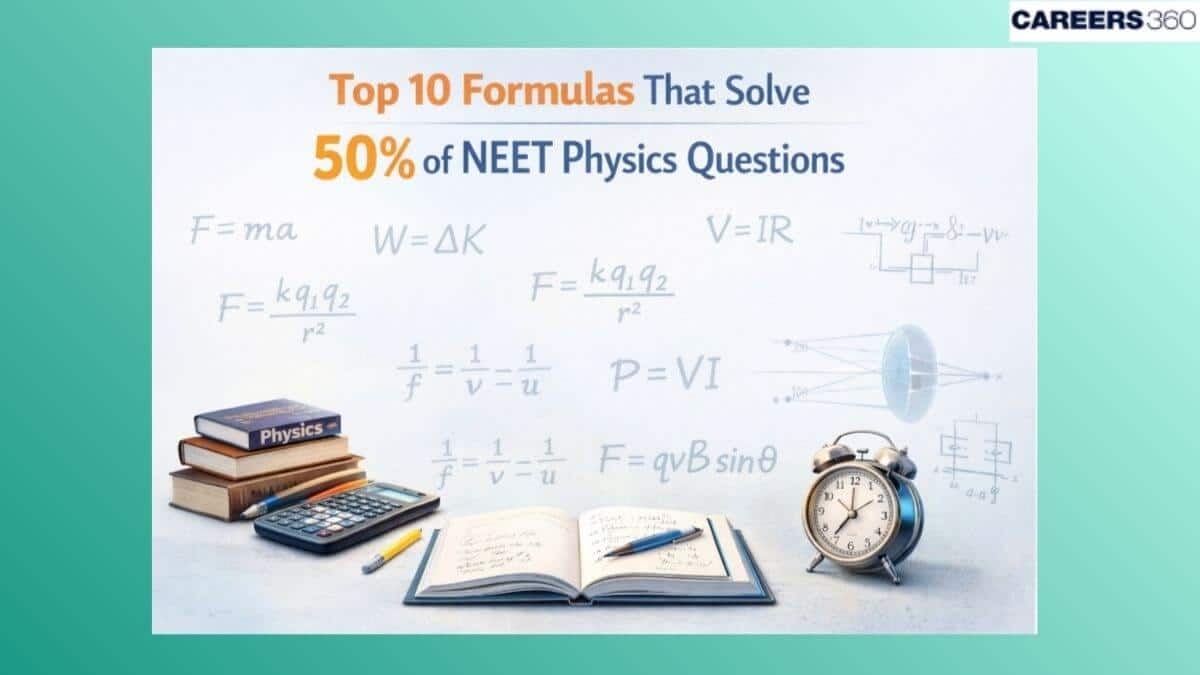
To score 620+ in NEET 2026, aspirants must master Physics formula‑based problem-solving rather than memorisation. These NEET Physics formulas simplify complex calculations and appear repeatedly in topics like Laws of Motion, Electrostatics, Current Electricity, Magnetism, Optics, and Modern Physics. Instead of revising the entire syllabus, focusing on the Top 10 high-weightage formulas allows you to solve nearly half of the NEET 2026 Physics section with speed and accuracy.
This article includes a structured breakdown of the most important NEET Physics formulas, the NEET chapter-wise weightage, and provides a practical strategy to master the topics efficiently. Here, we get:
Top 10 high-weightage NEET Physics formulas
Key applications for each formula
Related sub-formulas frequently asked in NEET
Strategy to use these formulas effectively
Practical tips to improve Physics score in NEET
Given below are some important physics formulas that appear in NEET repeatedly and are the backbone of multiple chapters. Many MCQs are based directly on these formulas.
The second law of Newton is the foundation of mechanics, which contributes the highest weightage in Physics for NEET. It is applied to problems related to inclined planes, pulley systems, block systems, and for the calculation of the net force of a system.
The work-energy theorem, W = ΔK, provides a shorter solution for many problems that require multi-step calculations by converting complicated force problems into simple energy comparisons.
This formula is often combined with the gravitational potential energy to be used for solving problems, including concepts like conservation of energy, elastic and inelastic collisions, rotational motions, etc.
Coulomb’s law is the core formula for solving all the problems coming from the topic of electrostatics.
It is basically applicable in:
Vector addition of forces
Electric field calculation
Equilibrium conditions
Get Job Ready in Healthcare | Employability-Focused Programs
This is the basic relation which helps in solving the problems related to series and parallel resistance, Internal resistance, calculation of electric potential difference, and the heating effect of the current.
This formula is directly used in solving the problems, including projectile motion, calculation of maximum height, and conservation of mechanical energy.
Every year, many questions in NEET are directly asked based on this formula.
By involving simple substitutions in power variations, many an MCQ based on the variation of resistance, consumption of power, and electrical appliances can be solved using this formula.
It is often observed that the problems related to power are common and straightforward.
This formula is used to determine the force on a charged particle in a magnetic field. It is often used in solving problems related to circular motion in a magnetic field, the direction of the magnetic field, etc.
Ray optics is considered to be a scoring unit in NEET Physics because most of the questions are directly formula-based rather than conceptual.
In such a case, the lens formula is used to deal with problems related to image formation, magnification, and the combination of lenses or compound lenses.
This formula from Modern Physics is used for problems like calculating the number of nuclei left, the percentage of substance left, the time required for the substance to reduce to a fraction, etc.
Get expert advice on college selection, admission chances, and career path in a personalized counselling session.
Knowing formulas alone won't help, but having a command of speed and accuracy will. NEET is a time-bound exam where each question comes with a limited time; therefore, here are a few tips that one should follow to score better by using these formulas.
Maintain a Dedicated Formula Notebook
Practice timed chapter-wise physics MCQs
Focus on Dimensional Analysis
Avoid Blind Memorisation
Many students study sincerely but somehow fail to convert preparation into marks, mainly because they lack structure, revision strategy, and exam requirements. Scoring good marks in physics requires clarity and discipline rather than random effort.
Start preparation with high-weightage physics chapters - Finishing high-weightage topics first, along with strengthening them with MCQ practice, prevents last-minute panic. Hence, one should cover high-weightage units in the NEET syllabus first, which becomes a necessity
Maintain an error log notebook - An error log notebook can be proven as one of the most powerful tools to improve an aspirant's Physics score. The more someone practices, the more they will come across errors and mistakes. This notebook will help them to solve and not repeat the same mistake in the future.
Revise formulas weekly - Physics is basically a formula-driven subject; any time wasted in deciding which formula to apply is simply a step towards losing marks in the main examination. Therefore, weekly NEET formula sheet revision is a must.
At the end, scoring good marks in NEET Physics isn't about mastering every single formula present in the syllabus, but it is about identifying the most important formulas and understanding their application deeply, along with continuous practice sessions.
Frequently Asked Questions (FAQs)
Yes. It is definitely realistic if one prepares strategically and focuses on high-weightage chapters along with consistent practice habits.
Yes, a large part of the questions is application-based and revolves around formulas directly.
Students should maintain a dedicated formula notebook and revise it regularly. Practising previous year questions and timed MCQs also helps in understanding how formulas are applied in different problems.

On Question asked by student community
Hello Savi
Please check the link below:
Hope it helps.
Hello, for AP NEET PG Category C seats, NRI documents are generally required if you are applying under the NRI quota, and eligibility depends on the applicable counselling rules. The fee payment currency and procedure should be confirmed from the current Dr. NTRUHS notification at its official website drntr.uhsap.in.
Hello, the NEET PG stipend at Parul University depends on the postgraduate course, academic year and applicable university policies.
Hello, some B.Sc Nursing colleges may offer admission without NEET, but the admission process depends on the college and its eligibility rules. You can find colleges offering B.Sc Nursing admission without NEET here: https://medicine.careers360.com/articles/bsc-nursing-admission-without-neet
Hello, you can pursue BPT in Kerala without NEET UG. Admission is generally based on the LBS Centre rank list and the applicable admission process. You can check BPT colleges in Kerala and their details here: https://medicine.careers360.com/colleges/list-of-bpt-in-physiotherapy-colleges-in-kerala
the product 'P' will be ,


| Column A | Column B |
| A |
a) Organisation of cellular contents and further cell growth. |
| B |
b) Leads to formation of two daughter cells. |
| C |
c) Cell grows physically and increase volume proteins,organells. |
| D |
d) synthesis and replication of DNA. |
Match the correct option as per the process shown in the
0.16 g of dibasic acid required 25 ml of decinormal solution for complete neutralisation. The modecular weight of the acid will be
32
64
128
256
0xone is

Know possible Govt/Private MBBS/BDS Colleges based on your NEET rank
College Predictors Webinars One to One Counselling Regular Updates Medical Almanac
Get Job Ready in Healthcare | Employability-Focused Programs
Ranked among the top Dental Colleges for 7 consecutive years by India Today poll
Ranked #19 by NIRF, NAAC A++ Accredited | Recognized by dental council of India