NEET PG College Predictor
NEET PG All India & State College Predictor with Admission Process Guide


The INI CET 2026 July session examination was successfully conducted on May 16, 2026, by AIIMS New Delhi. Candidates can now access the INI CET 2026 question paper PDF with memory-based questions, answer key solutions, subject-wise analysis, and expected difficulty review to evaluate performance, estimate scores, and understand the latest AIIMS exam trends. Check Now: INI CET May 2026 Detailed Exam Analysis
This Story also Contains
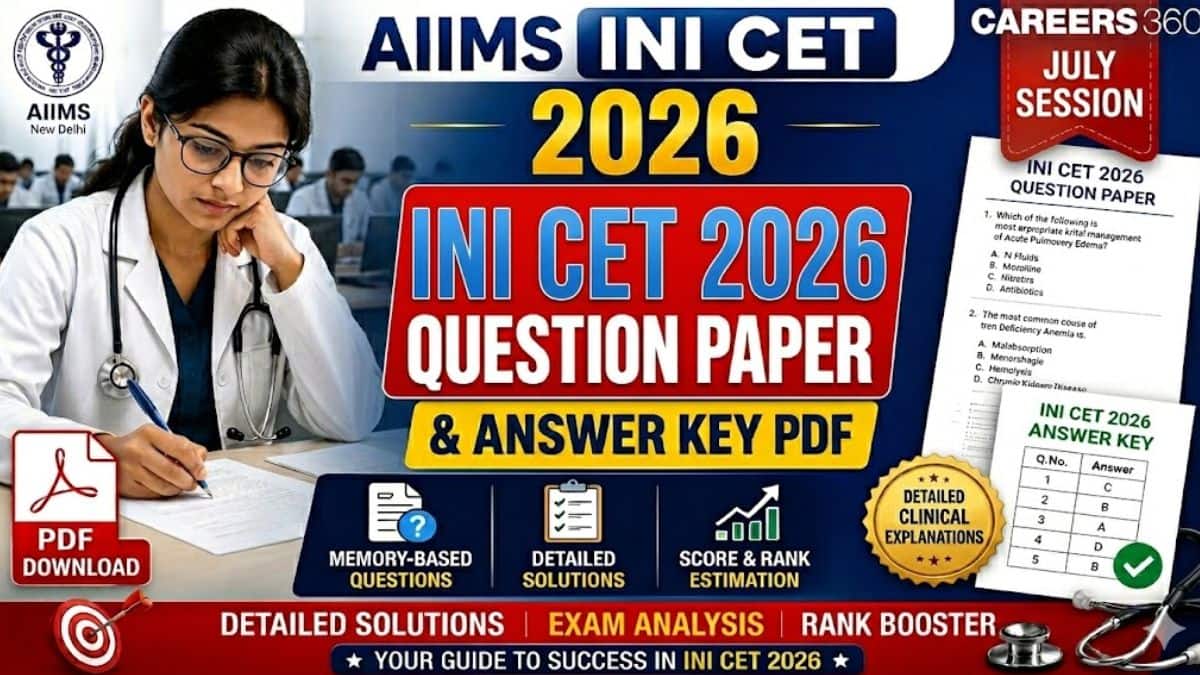
The INI CET 2026 question paper PDF with answer key and detailed solutions is now one of the most valuable post-exam resources for postgraduate medical aspirants. Candidates can use it to review actual memory-based questions, verify responses, calculate expected scores, analyse subject-wise difficulty, and estimate rank potential before official results are announced.
Although the session is called the July session due to admission and academic cycle timelines, the entrance examination itself is conducted earlier by AIIMS New Delhi. The INI CET Exam 2026 July session question paper PDF with memory-based questions, answer key solutions, and detailed subject-wise analysis is now available for candidates. This resource helps aspirants verify responses, calculate expected scores, estimate rank potential, and understand the latest AIIMS exam trends across Pre-Clinical, Para-Clinical, Clinical, and Dental sciences.
Understanding the INI CET 2026 exam pattern is important before solving the question paper or practising mock tests. It helps candidates know the number of questions, the marking scheme, and the subjects covered in the exam. Familiarity with the pattern allows students to plan their time effectively and improve accuracy during the test.
Particulars | Details |
Mode of Exam | Online (Computer-Based Test) |
Duration | 3 Hours (180 Minutes) |
Total Questions | 200 Multiple-Choice Questions (MCQs) |
Type of Questions | Objective |
Marking Scheme | +1 for every correct answer |
Negative Marking | -0.33 for each incorrect answer |
Unanswered Questions | No marks awarded or deducted |
Syllabus Level | MBBS standard – Pre-Clinical, Para-Clinical, and Clinical subjects |
Exam Conducting Body | All India Institute of Medical Sciences (AIIMS), New Delhi |
Get expert advice on college selection, admission chances, and career path in a personalized counselling session.
This section provides the most comprehensive and up-to-date INI CET May 2026 memory-based question paper with detailed subject-wise questions, correct answers, and concise explanations. These INICET 2026 questions are recalled by candidates who appeared in the May session for postgraduate medical admissions to AIIMS and other centrally funded institutes (CFIs). The question paper covers high-yield topics across Microbiology, Physiology, Biochemistry, Forensic Medicine & Toxicology, Dermatology, Anaesthesia, and Radiology, and will be updated progressively as more memory-based questions are submitted.
Question 1. A 40-year-old woman presents with malar telangiectasia, skin tightening suggestive of scleroderma, and progressive dyspnea on exertion. Echocardiography reveals a "fish-mouth" appearance of the mitral valve, attributed to chronic rheumatic heart disease. Which of the following microorganisms is most likely implicated in the pathogenesis of this valvular lesion?
A) Streptococcus pyogenes B) Staphylococcus aureus C) Streptococcus pneumoniae D) Corynebacterium diphtheriae
Answer: A) Streptococcus pyogenes (Group A Streptococcus)
Explanation: Rheumatic heart disease results from an autoimmune reaction following Group A Streptococcus pharyngitis. Molecular mimicry between streptococcal M protein and cardiac tissue antigens drives valvular damage, most commonly affecting the mitral valve and producing the characteristic "fish-mouth" stenosis.
Question 2. An epidemiologist studying an outbreak notes that all affected individuals develop symptoms within a short interval, with incidence peaking at nearly the same time. Which of the following diseases is most likely to produce such an epidemic curve?
A) Salmonellosis B) Staphylococcal food poisoning C) Measles D) Typhoid fever
Answer: B) Staphylococcal food poisoning
Explanation: A point-source epidemic curve with a sharp, near-simultaneous peak is characteristic of Staphylococcal food poisoning, as the preformed heat-stable enterotoxin acts within 1–6 hours of ingestion. All exposed individuals fall ill almost simultaneously, unlike propagated-source outbreaks (measles, typhoid), which display a prolonged epidemic curve.
Question 3. A patient with HIV infection presents with headache, fever, and altered sensorium. CSF examination shows budding yeast forms with an unstained capsule on Nigrosin preparation. What is the most likely organism?
A) Cryptococcus neoformans B) Candida albicans C) Histoplasma capsulatum D) Pneumocystis jirovecii
Answer: A) Cryptococcus neoformans
Explanation: Cryptococcus neoformans appears as budding yeast with a large clear halo (polysaccharide capsule) on India ink or Nigrosin staining. It is the most common cause of fungal meningitis in HIV patients, especially when CD4 count falls below 100 cells/mm³. The capsule is also detected by latex agglutination antigen test in CSF.
Question 4. Regarding ESBL-producing organisms, which of the following statements are correct?
A) 1, 3, 4 B) 1, 2, 4 C) 2, 3, 4 D) 3, 4
Answer: A) 1, 3, 4
Explanation: ESBL enzymes are typically plasmid-mediated, enabling horizontal gene transfer between organisms. They confer resistance to penicillins, cephalosporins (including 3rd generation), and aztreonam. Statement 2 is incorrect — ESBL producers are also resistant to penicillins (not susceptible). Carbapenems remain the drug of choice for serious ESBL infections.
Question 5. A 26-year-old sexually active male presents with multiple painful vesicular lesions over the penis and scrotum for 2–3 days, associated with burning sensation and dysuria. Grouped vesicles on an erythematous base are noted on examination. What is the most likely causative organism?
A) Haemophilus ducreyi B) Herpes simplex virus (HSV) C) Treponema pallidum D) Chlamydia trachomatis
Answer: B) Herpes simplex virus (HSV)
Explanation: Genital herpes (HSV-2 most commonly) presents with multiple painful grouped vesicles on an erythematous base with associated dysuria. This distinguishes it from syphilis (single painless chancre) and chancroid (painful but typically single ulcer). HSV-2 is the leading cause of recurrent genital ulcer disease worldwide.
Question 1. Which of the following cell junctions or junctional proteins are present in the specific structure marked with a black arrow?
A) Gap junctions B) Cadherins C) Hemidesmosomes D) Tight junctions
Answer: A) Gap junctions
Explanation: Gap junctions (connexons) are formed by connexin proteins and allow direct electrical and chemical communication between adjacent cells. They are especially critical in cardiac muscle (enabling coordinated contraction as a functional syncytium) and smooth muscle. They permit passage of ions and small molecules up to ~1 kDa between cells.
Question 2. Loss of hand–eye coordination is most commonly associated with a lesion of:
A) Temporal lobe B) Parietal lobe C) Occipital lobe D) Frontal lobe
Answer: B) Parietal lobe
Explanation: The posterior parietal cortex integrates somatosensory, visual, and proprioceptive information essential for visuospatial tasks and hand–eye coordination. Parietal lobe lesions cause optic ataxia — inability to use visual information to guide voluntary limb movement — a key component of Balint's syndrome seen with bilateral parieto-occipital lesions.
Question 3. Renin is secreted in response to:
A) Elevated sodium load to macula densa B) Elevated renal perfusion pressure C) Reduced renal perfusion pressure D) Increased extracellular fluid volume
Answer: C) Reduced renal perfusion pressure
Explanation: Renin is released by juxtaglomerular (JG) cells in response to three triggers: decreased renal perfusion pressure (stretch receptor/baroreceptor mechanism), reduced sodium delivery to macula densa (tubuloglomerular feedback), and increased sympathetic tone (β1 receptor stimulation). Elevated sodium load and increased perfusion pressure suppress renin secretion.
Question 4. Which of the following transporter activities is increased during oral rehydration therapy in diarrhoea?
A) CFTR B) NHE C) SGLT1 D) Na+–K+ ATPase
Answer: C) SGLT1
Explanation: SGLT1 (Sodium-Glucose Linked Transporter 1) is the scientific basis of ORS (Oral Rehydration Solution). It co-transports one glucose and two sodium ions across the apical enterocyte membrane, driving water absorption. Crucially, SGLT1 remains functional even in cholera (secretory diarrhea) since it is independent of the cAMP-mediated pathway exploited by cholera toxin.
Question 5. Biphasic flow in the right coronary artery is due to:
A) High pressure in right ventricle B) Low pressure in right ventricle C) Increased aortic pressure D) Increased right ventricular mass
Answer: B) Low pressure in right ventricle
Explanation: The left coronary artery is compressed during systole by high left ventricular pressure, resulting in predominantly diastolic flow. The right coronary artery shows biphasic (both systolic and diastolic) flow because right ventricular pressure is significantly lower and does not significantly compress intramyocardial vessels during systole — a unique feature of the low-pressure right heart.
Question 1. Oncogene addiction refers to a phenomenon in which cancer cells:
A) Depend predominantly on a single oncogenic pathway for survival, allowing targeted therapy against that pathway B) Become resistant to all forms of chemotherapy C) Develop due to addiction to carcinogenic substances D) Simultaneously activate multiple tumour suppressor genes
Answer: A) Depend predominantly on a single oncogenic pathway for survival, allowing targeted therapy against that pathway
Explanation: Oncogene addiction describes the paradoxical dependency of cancer cells on a single activated oncogene (e.g., BCR-ABL in CML, EGFR mutations in lung adenocarcinoma) for growth and survival. This vulnerability is therapeutically exploited using targeted inhibitors such as imatinib (BCR-ABL) and erlotinib (EGFR). Normal cells tolerate inhibition of these pathways far better than addicted cancer cells.
Question 2. Match the clinical conditions with the acid-base disorders:
| Clinical Condition | Acid-Base Disorder |
|---|---|
| A. Bronchopneumonia | 1. Metabolic acidosis |
| B. Pyloric stenosis | 2. Metabolic alkalosis |
| C. Hyperventilation | 3. Respiratory acidosis |
| D. Glycol poisoning | 4. Respiratory alkalosis |
A) 1-D, 2-B, 3-A, 4-C B) 1-B, 2-D, 3-C, 4-A C) 1-D, 2-C, 3-A, 4-B D) 1-A, 2-B, 3-D, 4-C
Answer: A) 1-D, 2-B, 3-A, 4-C
Explanation: Bronchopneumonia causes hypoventilation → CO2 retention → Respiratory acidosis (A→3). Pyloric stenosis causes repeated vomiting of HCl → Metabolic alkalosis (B→2). Hyperventilation causes excess CO2 loss → Respiratory alkalosis (C→4). Ethylene glycol poisoning generates glycolic and oxalic acids → Metabolic acidosis (D→1). Hence: A-3, B-2, C-4, D-1 → the answer reads 1-D, 2-B, 3-A, 4-C.
Question 3. Which of the following amino acid classifications are correctly matched?
A. Uncharged amino acid – Cysteine B. Nonpolar amino acid – Proline C. Basic amino acid – Histidine D. Basic amino acid – Lysine
A) A and B B) C and D C) B and C D) All of the above
Answer: D) All of the above
Explanation: All four pairings are correct. Cysteine has a polar but uncharged –SH side chain at physiological pH. Proline is a cyclic imino acid with a nonpolar ring that restricts peptide chain flexibility. Histidine contains an imidazole ring (pKa ~6) that can carry a positive charge near physiological pH, classifying it as basic. Lysine has an ε-amino group (pKa ~10.5) and is firmly classified as basic.
Question 4. Hypertriglyceridemia is seen in all of the following conditions EXCEPT:
A) Type 2 diabetes mellitus B) High fructose diet C) Abetalipoproteinemia D) Nephrotic syndrome
Answer: C) Abetalipoproteinemia
Explanation: Abetalipoproteinemia is caused by a deficiency of microsomal triglyceride transfer protein (MTP), resulting in failure to assemble apolipoprotein B-containing lipoproteins (chylomicrons, VLDL). This leads to fat malabsorption and very low (not elevated) plasma triglycerides. DM2, high fructose diet (increases hepatic de novo lipogenesis), and nephrotic syndrome (decreased LPL activity) all cause hypertriglyceridemia.
Question 1. Burn injury to the face and head in a bomb blast is categorised under:
A) Primary blast injury B) Secondary blast injury C) Tertiary blast injury D) Quaternary blast injury
Answer: D) Quaternary blast injury
Explanation: Blast injuries are classified as: Primary (hollow organ injury from overpressure blast wave), Secondary (fragmentation/shrapnel penetration), Tertiary (body displacement by blast wind causing blunt trauma), and Quaternary (all remaining injuries including burns, toxic inhalation, crush injuries, and flash burns to exposed areas like face and head). Burns from bomb blasts fall under the quaternary category.
Question 2. What is the ideal depth for the pigment deposition in the image?
A) Epidermis B) Superficial layer of dermis C) Deeper layer of dermis D) Beyond the skin
Answer: B) Superficial layer of dermis
Explanation: Permanent tattoo pigment is ideally deposited in the superficial (papillary) dermis. Epidermal pigment is lost with normal keratinocyte desquamation, making it transient. Deeper placement in the reticular dermis or subcutaneous tissue causes pigment to blur and spread over time. Papillary dermal placement ensures longevity and sharp definition of the tattoo for both cosmetic and medicolegal identification purposes.
Question 3. Match the following:
A. Carbon monoxide → 1. Bitter almond smell B. Organophosphorus → 2. Cherry red color C. Cyanide → 3. Garlicky odor D. Phosphorus → 4. Pinpoint pupils with secretions
A) A-1, B-3, C-2, D-4 B) A-2, B-4, C-1, D-3 C) A-1, B-2, C-4, D-3 D) A-3, B-2, C-1, D-4
Answer: B) A-2, B-4, C-1, D-3
Explanation: Carbon monoxide (A) forms carboxyhemoglobin, giving skin a cherry red discoloration. Organophosphorus (B) poisoning causes cholinergic excess (SLUDGE syndrome) with pinpoint pupils (miosis) and hypersecretion. Cyanide (C) produces a characteristic bitter almond odor. Phosphorus (D) has a distinctive garlicky smell and can cause luminescent ("glowing") vomitus and stools — "smoking stool syndrome."
Question 1. A patient presents with a painless black necrotic lesion over the heel with surrounding edema. What is the best investigation to confirm the diagnosis?
A) Skin biopsy B) KOH smear C) Gram stain D) Tzanck smear
Answer: A) Skin biopsy
Explanation: A painless black eschar with surrounding edema is the classic presentation of cutaneous anthrax (Bacillus anthracis) or ecthyma gangrenosum (Pseudomonas). Skin biopsy is the definitive investigation for histological identification of the causative organism and characteristic tissue changes. KOH preparation is used for fungi; Tzanck smear for herpetic/pemphigoid lesions; Gram stain provides preliminary bacterial identification but is not confirmatory.
Question 2. A neonate is brought with a blistering lesion. The baby is feeding normally and has no fever, hypotension, or signs of shock. What is the most probable diagnosis?
A) Staphylococcal scalded skin syndrome B) Bullous pemphigoid C) Epidermolysis bullosa D) Pemphigus due to transplacental antibodies
Answer: C) Staphylococcal scalded skin syndrome
Explanation: Staphylococcal scalded skin syndrome (SSSS) in neonates is caused by exfoliative toxins (ET-A and ET-B) from Staphylococcus aureus, which cleave desmoglein-1 in the superficial epidermis, producing widespread blistering without systemic toxicity (the baby feeds normally, no septic shock). Epidermolysis bullosa is a congenital mechanical fragility disorder due to structural protein gene mutations, present from birth and not toxin-mediated.
Question 1. Which of the following drugs does NOT typically cause respiratory paralysis/depression in overdose?
A) Phenobarbitone B) Opioids C) Thiopentone D) Ketamine
Answer: D) Ketamine
Explanation: Ketamine is a dissociative anaesthetic (NMDA receptor antagonist) that uniquely preserves spontaneous respiration, airway protective reflexes, and laryngeal tone even at anaesthetic doses. This sets it apart from barbiturates, opioids, and benzodiazepines, all of which cause dose-dependent respiratory depression. Ketamine is therefore the preferred agent for procedural sedation in patients at risk of airway compromise, including paediatric patients and those in resource-limited settings.
Question 2. A 45-year-old woman undergoes surgery for a parotid swelling under general anaesthesia. Ten minutes after induction, she develops rapid rise in end-tidal CO2 (EtCO2), increasing body temperature, tachycardia, and hypertension. What is the most likely diagnosis?
A) Malignant hyperthermia B) Heat stroke C) Heat exhaustion D) Neuroleptic malignant syndrome
Answer: A) Malignant hyperthermia
Explanation: Malignant hyperthermia (MH) is a life-threatening pharmacogenetic hypermetabolic crisis triggered by volatile anaesthetics (e.g., halothane, sevoflurane) or succinylcholine. It is caused by mutations in the RYR1 gene (ryanodine receptor), leading to uncontrolled calcium release from the sarcoplasmic reticulum. The classic triad — rapidly rising EtCO2, hyperthermia, and rigidity appearing minutes after anaesthetic induction — is pathognomonic. Dantrolene is the specific antidote.
Question 3. During a lumbar puncture, the following structures are pierced:
A) 5 → 3 → 1 → 2 → 4 B) 3 → 5 → 1 → 2 → 4 C) 5 → 1 → 3 → 2 → 4 D) 5 → 3 → 2 → 1 → 4
Answer: A) 5 → 3 → 1 → 2 → 4
Explanation: During lumbar puncture, the needle traverses layers from superficial to deep: Skin → Subcutaneous fat → Supraspinous ligament (5) → Interspinous ligament (3) → Ligamentum flavum (1) → Epidural space → Dura mater (2) → Subdural space → Arachnoid mater (4) → Subarachnoid space (CSF collected here). The mnemonic "SIL-DA" (Supra, Inter, Ligamentum flavum, Dura, Arachnoid) aids recall.
Question 4. Regarding the hemodynamic effects of halothane anaesthesia, which of the following statements are correct?
A) 1, 3, 4 B) 1, 2, 3 C) 1, 2, 4 D) 2, 3, 4
Answer: C) 1, 2, 4
Explanation: Halothane directly depresses myocardial contractility (1 ✓), reducing cardiac output. Blood pressure falls initially after induction and then plateaus at a lower level (2 ✓) — it does not progressively decrease irrespective of depth (3 ✗). Halothane sensitises the myocardium to catecholamines (4 ✓), significantly increasing ventricular arrhythmia risk, which is why adrenaline co-administration must be strictly limited during halothane anaesthesia.
Question 1. An ultrasonography image of the right iliac fossa is given. The patient presented after 48 hours of pain. What is the most appropriate next step in management?
A) Surgery B) CECT C) Percutaneous drainage D) USG Guided Drainage
Answer: B) CECT
Explanation: In a patient presenting with right iliac fossa pain after 48 hours — beyond the window for straightforward appendicitis — there is heightened concern for complications such as appendicular mass, perforation, or abscess. When USG findings are equivocal or a complication is suspected, CECT abdomen is the next best step, offering superior sensitivity and specificity for detecting appendicitis, perforation, abscess formation, and alternative diagnoses compared to USG alone.
To access more such memory-based questions with detailed answers and subject-wise explanations, download the complete INI CET May 2026 Question Paper with solution PDF.
| INI CET May 2026 Question Paper with Answer Key & Detailed Solutions PDF (Memory-Based) | Download Link |
This INI CET May 2026 question paper is memory-based and compiled from candidate recall. Questions and answers will be updated progressively. For official results and admit cards, visit the AIIMS official website.
The INI CET 2026 answer key with detailed solutions is now available, offering candidates subject-wise correct answers, clinical explanations, and score estimation support immediately after the exam. The answer key helps aspirants cross-check responses, calculate expected scores, and understand the reasoning behind each correct option.
Key benefits of the INI CET 2026 answer key PDF include:
By analysing the INI CET 2026 answer key with solutions, candidates can estimate rank range, counselling potential, and overall performance before official AIIMS results are released.
The INI CET 2026 July session paper was overall moderate to moderately difficult, maintaining AIIMS’ traditional emphasis on conceptual clarity, clinical reasoning, and integrated subject application.
Pre-Clinical: Moderate
Para-Clinical: Moderate to difficult
Clinical: Moderate to difficult with highest scoring impact
Overall Analysis: Candidates with strong conceptual preparation and clinical integration found the paper manageable, while rote-focused preparation may have struggled with advanced application-based questions.
Check Now: INI CET May 2026 Detailed Exam Analysis
Students can now download the INI CET 2026 July session memory-based question paper PDF with answer key, subject-wise solutions, and expert-reviewed explanations. This downloadable resource helps candidates evaluate performance, calculate expected scores, analyse question trends, and strengthen future postgraduate medical exam preparation.
The INI CET 2026 question paper PDF download will help aspirants:
Understanding the INI CET 2026 marking scheme is essential for accurately calculating expected scores and estimating potential rank before official AIIMS results are declared.
Response Type | Marks Awarded |
Correct Answer | +1 mark |
Incorrect Answer | -0.33 mark |
Unanswered | 0 mark |
(Total Correct × 1) – (Total Incorrect × 0.33)
Using the INI CET 2026 answer key and marking scheme allows candidates to:
Accurate score estimation helps candidates make more informed decisions regarding counselling strategy and future exam planning.
Frequently Asked Questions (FAQs)
The official answer key is usually released by AIIMS New Delhi within a week after the exam.
For every correct answer, +1 mark is awarded; for every incorrect answer, −0.33 mark is deducted; unanswered questions carry 0 marks.
The paper includes Medicine, Surgery, Pediatrics, Obstetrics & Gynecology, and Dental Sciences (MDS).

On Question asked by student community
Hello there,
If your provisional registration expired in July 2026, you should get it renewed or obtain your permanent registration as soon as possible. An expired registration may create an issue during document verification or admission.
You can still check your INI-CET eligibility for the relevant session. Still, I strongly
You can download the INI CET previous year papers from the link given below:
Hello Student,
INI SS Round 2 seat allotment was released on July 9. I am sharing a link where you can find the seat allotment list and other details.
Article Link - INI SS July 2026 Counselling Round 2 Seat Allotment Result OUT: Direct Link.
Hello Aniket,
Please refer to the given link to access the INI-CET solved previous year question papers. In this article, we have provided all the previous years' question papers in one place for your convenience.
Hope this helps!
Hello Dear Student,
For the May 2026 session (conducted in July 2025, results released May 23, 2026), the Round 1 cutoff rank for the ST category is 31,313 .
January 2026 Session (Round 1 ST Cutoff): 27,569
May 2026 Session (Round 1 ST Cutoff): 31,313
You can get directly find,

NEET PG All India & State College Predictor with Admission Process Guide
End-to-End NEET PG Admission Guidance | One-to-One Counselling | College Predictors | Regular Updates | E-books