JSS University Mysore Allied Sciences 2026
NAAC A+ Accredited| Ranked #21 in University Category by NIRF | Applications open for multiple UG & PG Programs


Preparing for NEET 2026? These Biology NCERT Line-by-Line Questions are designed to help you master every concept directly from NCERT, where most NEET Biology questions are sourced. Since Biology carries the highest weightage in NEET, practicing line-by-line MCQs ensures you don’t miss any frequently asked concepts or hidden details.
This Story also Contains

This set covers high-scoring units like Genetics, Ecology, Plant Physiology, and Human Physiology, making it a powerful tool for complete syllabus revision. These NCERT-based Biology MCQs are especially effective for last-minute revision, active recall, and improving accuracy before the NEET exam.
NEET 2026 aspirants can access a PDF of NCERT Biology line-by-line questions covering both class 11 and class 12 chapters. The PDF includes MCQs, statement-based questions, and important biology diagram-based practice directly aligned with NCERT textbooks. Downloading the NCERT Biology question bank helps in quick revision and error-free NEET 2026 preparations. It covers NEET Biology important questions with solutions that are NCERT-based.
|
Biology NCERT Line-by-Line Questions |
NEET 2026 aspirants who are well-prepared by practising MCQs can score 330+ in Biology.
Get expert advice on college selection, admission chances, and career path in a personalized counselling session.
The NEET biology preparation includes Class 11 NCERT Biology chapters covering Diversity of Living Organisms, Cell Biology, Plant Physiology and Human Physiology. The Class 12 NCERT Biology chapters include Genetics, Evolution, Reproduction, Biotechnology, and Ecology. So practising NCERT line‑by‑line questions from both classes provides complete syllabus coverage and boosts accuracy in NEET 2026 Biology.
Here are some NCERT Biology Line‑by‑Line Questions for NEET 2026:
Q1.
Consider the following statements regarding human reproduction:
I. Fertilisation occurs in the ampullary region of the fallopian tube
II. Cleavage starts after implantation
III. Zygote undergoes mitotic divisions
(1) I and III only
(2) II and III only
(3) I and II only
(4) I, II and III
Correct Answer: (1)
Explanation: Cleavage starts before implantation.
Q2.
Which of the following is the highest taxon in the taxonomic hierarchy, and which is the most specific? Also, what is the correct ascending order of taxonomic categories?
(a) Kingdom highest, Species most specific; Species → Genus → Family → Order → Class → Phylum → Kingdom
(b) Species highest, Kingdom most specific; Kingdom → Phylum → Class → Order → Family → Genus → Species
(c) Kingdom highest, Genus most specific; Genus → Species → Family → Order → Class → Phylum → Kingdom
(d) Phylum highest, Species most specific; Species → Family → Genus → Order → Class → Kingdom → Phylum
Correct Answer: (a)
Explanation: Kingdom is the highest, and Species is the most specific; the correct ascending hierarchy is followed.
Q3.
In the Five Kingdom classification by Whittaker, the kingdom Monera includes organisms that are prokaryotic. Which of the following is NOT a feature of Monerans?
(a) Absence of a membrane-bound nucleus
(b) The cell wall is present in all
(c) Mode of nutrition can be autotrophic or heterotrophic
(d) They reproduce only sexually
Correct Answer: (d)
Explanation: Monerans reproduce mainly asexually (binary fission).
Q4. What is true for both (a) and (b)?
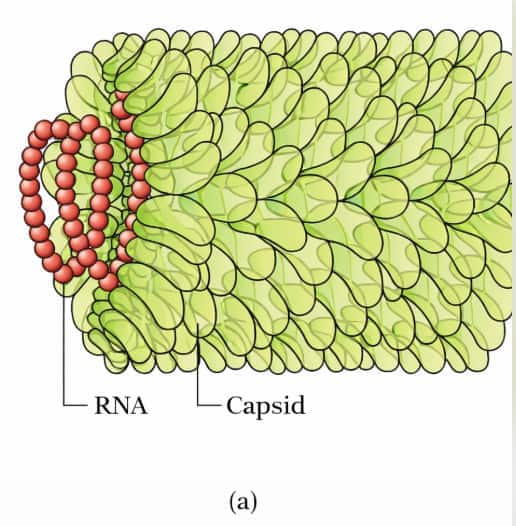
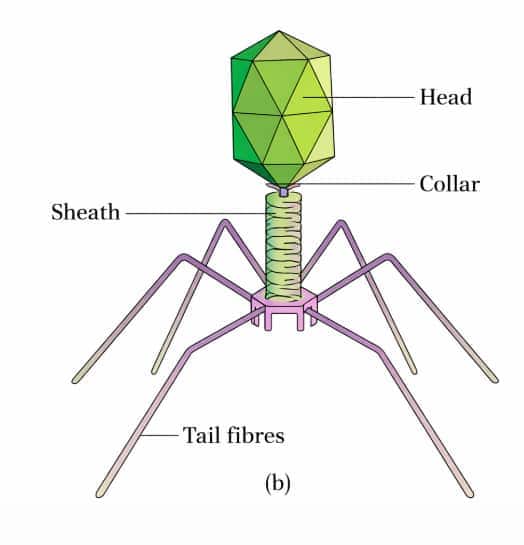
(a) RNA is the genetic material
(b) Capability to infect bacteria
(c) Being obligate endoparasites
(d) Can be killed by antibiotics
Correct Answer: (c)
Explanation: Both are obligate parasites; antibiotics do not affect viruses.
Q5. Mycorrhiza is an example of which type of symbiotic association? Also, which fungi are involved, and what do they provide to the host plant?
(a) Parasitism; fungi take nutrients from plants
(b) Commensalism; fungi are unaffected
(c) Mutualism; fungi provide water and minerals
(d) Predation; fungi kill plant cells
Correct Answer: (c)
Explanation: Fungi absorb water & minerals (especially phosphorus); plants provide food.
Aspirants need a structured NEET 2026 study plan to cover the whole syllabus effectively multiple times. Nearly 90% of NEET Biology questions are directly NCERT-based. Line-by-line practice helps aspirants to master concepts, definitions, and factual details that cover the most repeated questions in NEET exam. This will help in analysing important NEET biology questions that are directly line-by-line based. NCERT Biology is considered the most authentic source for NEET study material and helps in scoring a higher AIR.
Start chapter-wise Biology MCQs practice from class 11 and class 12.
Focus on the NCERT Biology diagrams and concepts to ace the questions based on them.
To test the conceptual clarity of the NEET biology syllabus, use assertion-reason and statement-based MCQs.
Revise according to Biology high-weightage chapters like Genetics, Ecology, Reproduction, and Physiology multiple times.
Attempt the Biology mock test and previous year papers with these NCERT MCQs.
Also, follow a structured revision strategy to cover the whole syllabus efficiently.
It covers complete syllabus coverage with MCQ practice based on the NEET 2026 exam pattern.
Improve speed and accuracy by solving Biology MCQs. This will help in NEET 2026 exam day strategy preparation.
Builds confidence in diagram-based and assertion reason question through regular practice.
It also helps in NEET 2026 last-minute preparation by covering important concepts.
Frequently Asked Questions (FAQs)
NCERT line-by-line questions cover most of the concepts and facts asked in NEET Biology, but students should also practise previous year papers and mock tests for better exam readiness.
Ideally, students should revise NCERT Biology at least 3–4 times along with solving line-by-line MCQs to strengthen retention and accuracy.
Yes, NCERT-based MCQs include diagram-based, statement-based, and assertion-reason questions, which are commonly asked in NEET exams and help improve conceptual clarity.

On Question asked by student community
Hello, you can pursue BPT in Kerala without NEET UG. Admission is generally based on the LBS Centre rank list and the applicable admission process. You can check BPT colleges in Kerala and their details here: https://medicine.careers360.com/colleges/list-of-bpt-in-physiotherapy-colleges-in-kerala
Hello Student,
If you are looking for information about NEET PG 2025 DNB seat allotment and the fees payable at the allotted college or hospital, DNB seats are allotted through the respective counselling process based on your rank, category, choice of speciality, and seat availability.
For the 2025 session, the
Dear Student, with a NEET PG 2026 rank of 6,600 in the EWS category, your options should be assessed using the relevant counselling year's college-wise closing ranks, category-wise seats and counselling round. Please also confirm whether you are applying through the applicable All India counselling route or another quota. That
Hello
If you mean whether a school/college will be strict about attendance when you are preparing for NEET UG, it depends on the institution’s rules. NEET preparation itself is generally not a reason to ignore regular attendance.
For example, CBSE requires 75% attendance for board-exam eligibility, with limited relaxation for
Hello Student,
Aapke NEET marks 372 aur AIR 3,51,532 hain. Lekin 3rd round mein MBBS seat ke liye counselling karani chahiye ya nahi, iska sahi answer dene ke liye mujhe aapki category, domicile state, aur aap AIQ se counselling kar rahe hain ya state quota se—ye details chahiye.
In details
the product 'P' will be ,


| Column A | Column B |
| A |
a) Organisation of cellular contents and further cell growth. |
| B |
b) Leads to formation of two daughter cells. |
| C |
c) Cell grows physically and increase volume proteins,organells. |
| D |
d) synthesis and replication of DNA. |
Match the correct option as per the process shown in the
0.16 g of dibasic acid required 25 ml of decinormal solution for complete neutralisation. The modecular weight of the acid will be
32
64
128
256
0xone is

Know possible Govt/Private MBBS/BDS Colleges based on your NEET rank
College Predictors Webinars One to One Counselling Regular Updates Medical Almanac
Highest Package: ₹32 LPA | Placement Rate: 90% students placed | 5000+ Students Placed 900+ Placements Recruiters | Scholarships Available
33.5 LPA-Highest Package | Up to 100% scholarship worth 30 CR
Get Job Ready in Healthcare | Employability-Focused Programs
Get Started With Your Healthcare Career. 2026 Admissions open.