Emversity Allied Health Programs
Get Job Ready in Healthcare | Employability-Focused Programs


NTA may quietly remove some of the most predictable question types from Re-NEET 2026 — and historical re-exam data already shows the pattern. Previous re-tests saw graph questions almost disappear, diagram-based Biology sharply reduce, and Physics numericals nearly double. Students still preparing with old mock test patterns may lose major marks. This isn't a guess; it's historical fact.
Check now: Can You Crack Re-NEET 2026 in 30 Days
This Story also Contains
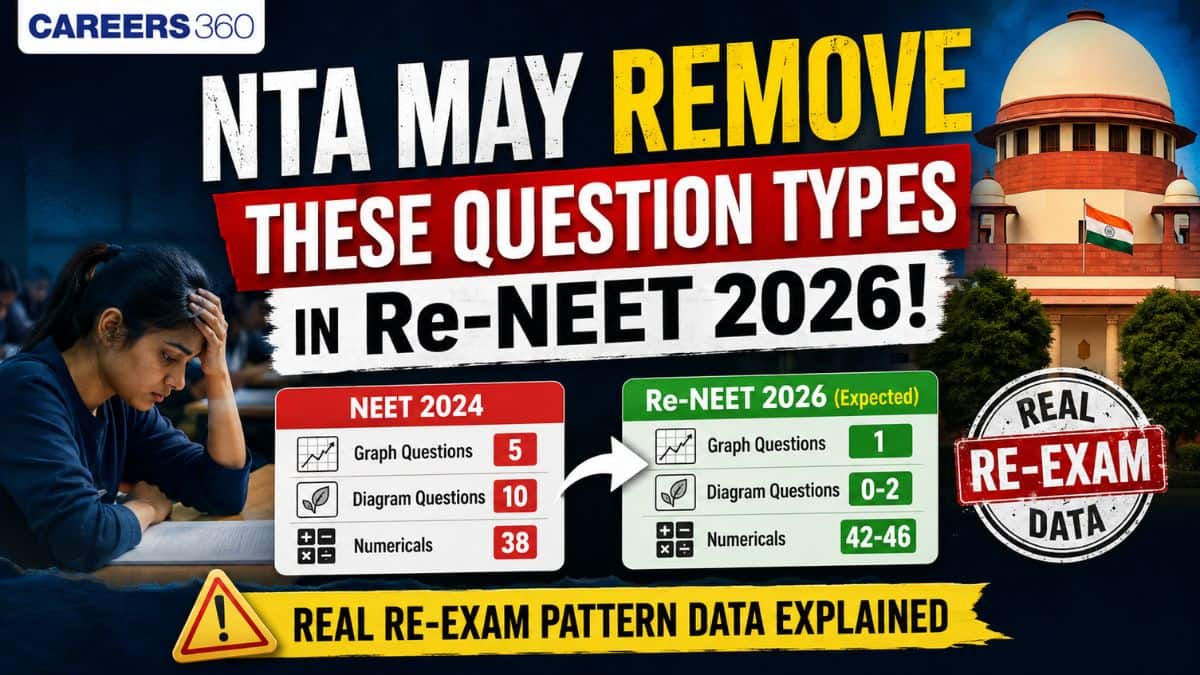
In the AIPMT 2015 re-test, diagram questions moved from 13 down to just 2. Graph questions were completely eliminated, dropping from 4 to 0. Fast forward to the NEET 2024 re-test, and graph questions were nearly wiped out again, dropping from 5 to 1.
So, if visual interpretation questions are being removed, what replaces them? The answer is Numericals. Re-tests heavily favor students who can calculate efficiently. In the NEET 2024 re-test, Physics numericals literally doubled, jumping from 13 to 26 out of 50 questions.
This means Re-NEET 2026 may not follow the same balance of question types seen in the original NEET UG 2026 paper.
For Re-NEET 2026, the data predicts only 0 to 2 diagram questions and 1 to 2 graph questions. Instead, expect an overall spike to about 42 to 46 numericals, with Physics adding 3 to 5 extra calculation-based questions.
Stop spending hours memorising complex diagrams! Shift your focus to formula-based numericals, especially in Mechanics and Modern Physics. Students who adapt early to this pattern shift may gain a major advantage in speed, accuracy, and rank improvement.
After the NEET UG 2026 cancellation controversy, lakhs of aspirants are now trying to predict one major thing about the upcoming Re-NEET 2026 examination: Will NTA change the question paper pattern in the re-exam?
Historical re-exam data now suggests that the answer may be yes.
Get expert advice on college selection, admission chances, and career path in a personalized counselling session.
Previous re-exam data shows a clear shift away from graph-based and visual questions toward numericals and calculation-heavy patterns.
|
Question Type |
AIPMT → Re-AIPMT |
NEET 2024 → Re-NEET 2024 |
Final Trend |
|
Graph Questions |
4 → 0 |
5 → 1 |
Nearly eliminated |
|
Diagram Questions |
13 → 2 |
10 → 8 |
Reduced |
|
Numericals |
+5 |
+12 |
Increased heavily |
|
Chemistry Difficulty |
Harder |
Harder |
Consistently tougher |
|
Theory Questions |
Similar |
Increased |
NCERT-heavy |
|
Statement Questions |
Increased |
Reduced |
Unstable |
|
Biology Difficulty |
Slightly easier |
Harder |
Mixed |
|
Physics Pattern |
Easier |
More numerical-heavy |
Calculation-focused |
The strongest repeated pattern across both re-exams is:
Graph questions reduce sharply.
Numericals increase significantly.
And chemistry becomes more difficult.
Get Job Ready in Healthcare | Employability-Focused Programs
A detailed comparison between the original NEET/AIPMT papers and their re-exams reveals a surprisingly consistent pattern: some question types sharply reduce during re-tests, while others suddenly increase. Based on previous re-exams, NTA appears to shift the paper away from predictable visual questions and toward more calculation-heavy and concept-driven questions.
One major trend stands out clearly:
Graph-based questions almost disappear in re-exams.
At the same time:
numericals increase,
Chemistry becomes tougher,
Biology remains NCERT-heavy,
and the overall paper often becomes longer and mentally exhausting rather than directly “hard.”
This is exactly why understanding previous re-exam behaviour has become extremely important for Re-NEET 2026 preparation.
Also Read:
Analysis of both :
AIPMT 2015 → Re-AIPMT 2015
NEET 2024 → Re-NEET 2024
shows repeated structural changes in the question paper.
Key Insight: Previous re-exams consistently showed -
Graph-based questions almost disappearing
Diagram questions reducing
Numericals increasing sharply
Chemistry becoming tougher overall
Watch detailed visual breakdown of how graph questions disappeared and numericals increased in previous Re-NEET papers:
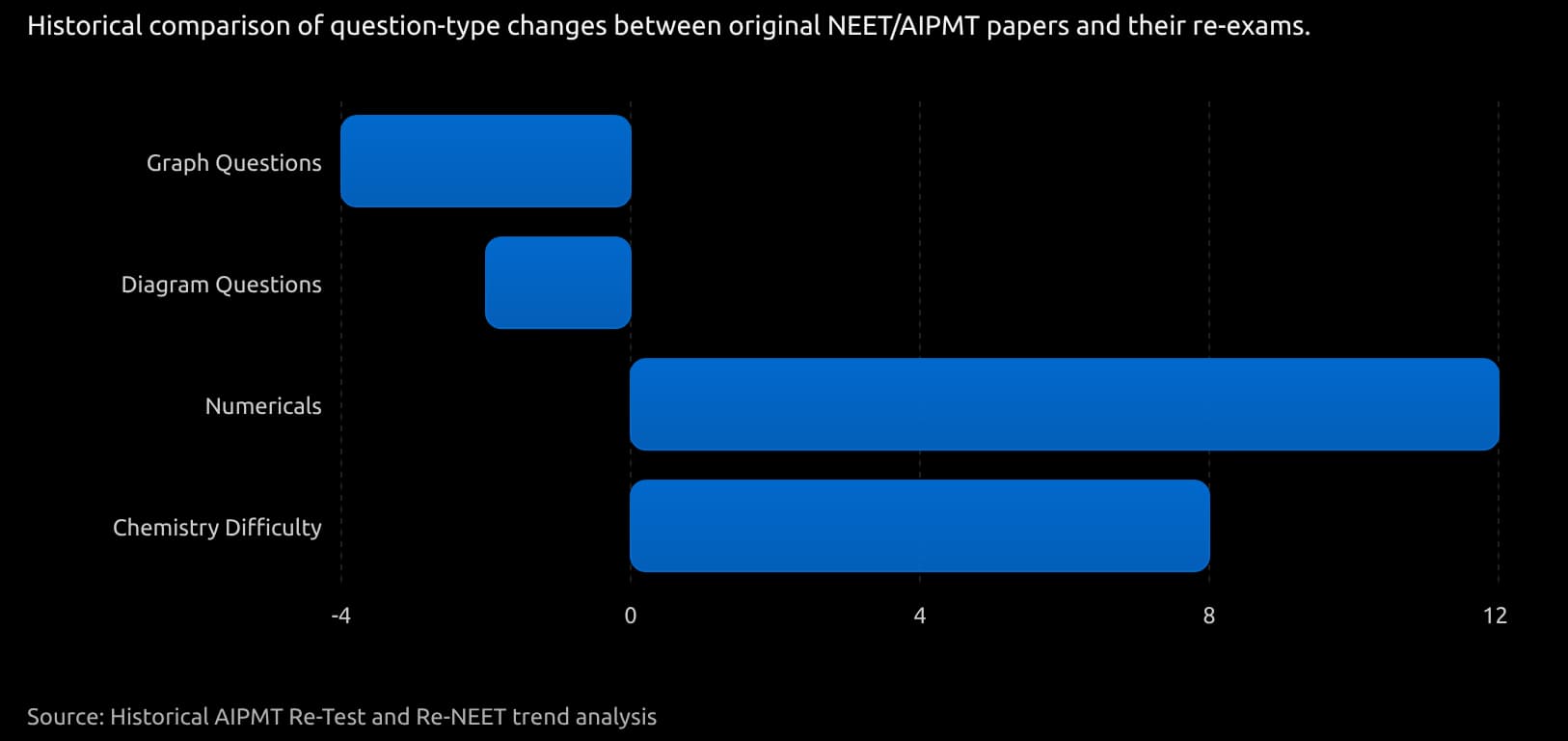
The chart below shows how graph questions almost disappeared while numericals sharply increased in previous re-exams.
One of the most surprising observations from previous re-exams is the near elimination of graph-based questions.
Data shows:
Re-AIPMT 2015: Graph questions dropped from 4 to 0
Re-NEET 2024: Graph questions dropped from 5 to 1
This suggests that NTA may intentionally reduce highly visual and interpretation-heavy question formats during re-exams. Instead, the paper shifts toward:
direct NCERT concepts,
lengthy calculations,
statement evaluation,
and elimination-based MCQs.
This trend becomes extremely important for students heavily relying on graph prediction practice.
Another major pattern visible in both re-exams is the reduction of diagram-based Biology questions.
Historical trend:
AIPMT diagrams: 13 → 2
NEET 2024 diagrams: 10 → 8
The reduction was dramatic in AIPMT and moderate in NEET 2024, but the overall trend still suggests fewer diagram-based questions during re-tests.
This does NOT mean students should skip NCERT diagrams completely.
Instead, it suggests that:
direct diagram identification questions may reduce,
while NCERT line-based theory and statement-based Biology could increase.
Biology is still expected to remain heavily NCERT-dependent in Re-NEET 2026.
This single pattern shift may decide thousands of ranks in Re-NEET 2026.
High-Value NEET 2026 Study Resources for Maximum Score:
While graph and diagram questions reduce, numericals show the exact opposite trend.
Historical re-exam analysis shows:
Re-AIPMT numericals increased by +5
Re-NEET numericals increased by +12
Physics numericals almost doubled in the Re-NEET paper.
This suggests that Re-NEET 2026 could become:
more calculation-intensive,
more time-consuming,
and mentally exhausting under pressure.
Many students wrongly assume re-exams become easier. Actual data shows the opposite.
Re-tests often become harder because:
calculation load increases,
time pressure increases,
and Chemistry becomes more conceptual.
Across both historical re-exams, Chemistry consistently became tougher.
Trend:
Re-AIPMT Chemistry: harder
Re-NEET Chemistry: significantly harder
Expected shifts for Re-NEET 2026:
more reaction-based questions,
Physical Chemistry calculations,
NCERT exception lines,
Organic mechanism traps,
conceptual Inorganic Chemistry.
Many experts now believe Chemistry could become the biggest differentiator in Re-NEET 2026 rankings.
Despite pattern changes, one thing remains highly stable across re-exams:
Biology continues to stay NCERT-heavy.
Previous analysis shows:
theory questions remain dominant,
NCERT factual lines continue to appear,
and statement-based traps become important.
Students preparing for Re-NEET 2026 should prioritise:
NCERT line-by-line Questions’ revision,
Examples,
Tables,
Exceptions,
and repeated PYQ concepts.
Skipping NCERT for advanced books right now could become a major mistake.
Experts and students believe the re-exam pattern shift may happen for multiple reasons:
reducing predictability,
preventing coaching-based guesswork,
minimising leaked-pattern advantages,
reducing rank inflation,
increasing conceptual filtering.
This does not necessarily mean “impossible” questions.
Instead, the paper may feel harder because it becomes:
longer,
more calculation-heavy,
mentally draining,
and accuracy-dependent.
Instead of chasing rumours, students should now prioritise:
Physics numericals,
Chemistry conceptual practice,
mock test analysis,
and time management.
Most importantly, students should prepare for a paper that may feel longer and more exhausting, not necessarily impossible.
Based on historical re-exam data, the most likely changes in Re-NEET 2026 are:
Graph questions may almost disappear
Diagram-based questions could reduce
Numericals may increase sharply
Chemistry could become tougher
Biology may stay NCERT-heavy
The paper may become more time-consuming overall
Re-NEET 2026 preparation is no longer just about revising the syllabus again. Historical re-exam data suggests that NTA may significantly change question behaviour by reducing graph and diagram-based questions while increasing numericals and conceptual Chemistry. Students who understand this shift early may gain a major advantage in speed, accuracy, and overall rank improvement before the re-exam.
Access Other Preparation Resources:

On Question asked by student community
Hello Savi
Please check the link below:
Hope it helps.
Hello, for AP NEET PG Category C seats, NRI documents are generally required if you are applying under the NRI quota, and eligibility depends on the applicable counselling rules. The fee payment currency and procedure should be confirmed from the current Dr. NTRUHS notification at its official website drntr.uhsap.in.
Hello, the NEET PG stipend at Parul University depends on the postgraduate course, academic year and applicable university policies.
Hello, some B.Sc Nursing colleges may offer admission without NEET, but the admission process depends on the college and its eligibility rules. You can find colleges offering B.Sc Nursing admission without NEET here: https://medicine.careers360.com/articles/bsc-nursing-admission-without-neet
Hello, you can pursue BPT in Kerala without NEET UG. Admission is generally based on the LBS Centre rank list and the applicable admission process. You can check BPT colleges in Kerala and their details here: https://medicine.careers360.com/colleges/list-of-bpt-in-physiotherapy-colleges-in-kerala
the product 'P' will be ,


| Column A | Column B |
| A |
a) Organisation of cellular contents and further cell growth. |
| B |
b) Leads to formation of two daughter cells. |
| C |
c) Cell grows physically and increase volume proteins,organells. |
| D |
d) synthesis and replication of DNA. |
Match the correct option as per the process shown in the
0.16 g of dibasic acid required 25 ml of decinormal solution for complete neutralisation. The modecular weight of the acid will be
32
64
128
256
0xone is

Know possible Govt/Private MBBS/BDS Colleges based on your NEET rank
College Predictors Webinars One to One Counselling Regular Updates Medical Almanac
Get Job Ready in Healthcare | Employability-Focused Programs
Ranked among the top Dental Colleges for 7 consecutive years by India Today poll
Ranked #19 by NIRF, NAAC A++ Accredited | Recognized by dental council of India