SRM Kattankulathur Dental College and Hospital, Kattankulathur
Ranked #19 by NIRF, NAAC A++ Accredited | Recognized by dental council of India


Physical Chemistry Chapters for NEET 2027 consist of Numericals, Chemical Calculations, Formulae, and Concepts. Chapters like Some Basic Concepts of Chemistry, Thermodynamics, Equilibrium, Solutions, Electrochemistry, and Chemical Kinetics require concept clarity along with solving NEET sample papers. They should revise the formulae as well as the concepts and then solve questions from the same.
This Story also Contains
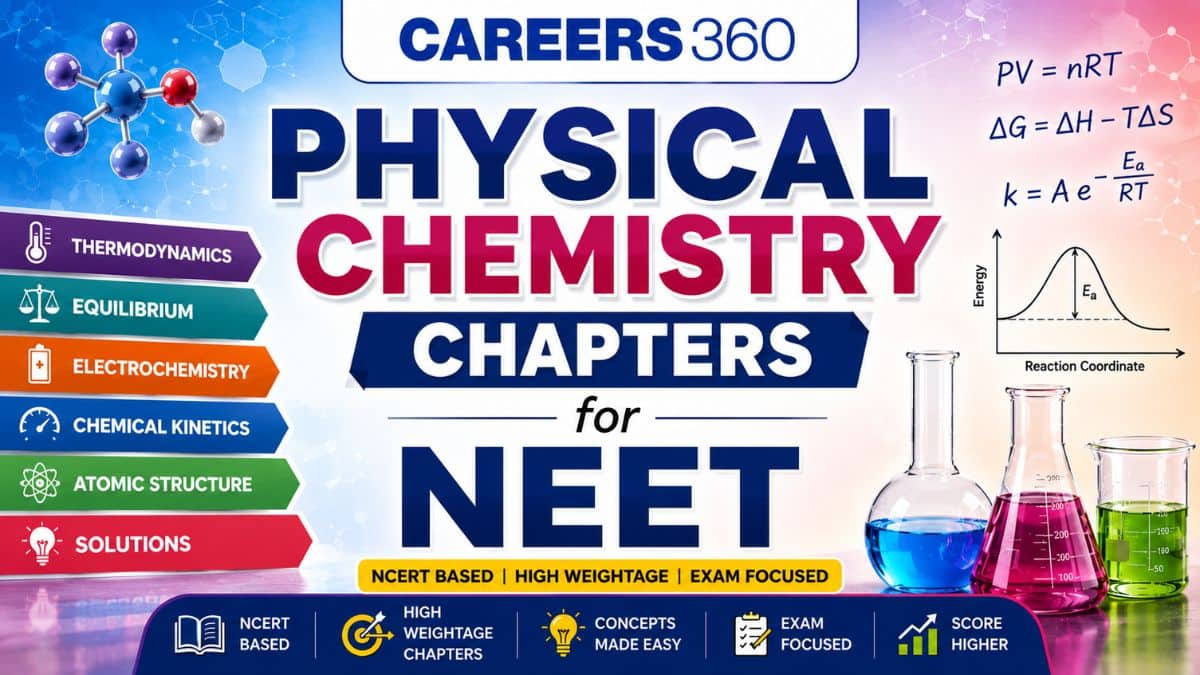
The NEET Physical Chemistry syllabus is as per the one given by the National Medical Commission (NMC). Aspirants should follow the NEET 2027 syllabus in accordance with the old syllabus and new syllabus available on the websites of the NMC and NTA. In this article, NEET 2027 Physical Chemistry chapters, their weightage, topics, NEET important questions, books, and preparation tips have been discussed.
Physical Chemistry forms a vital component of the NEET Chemistry syllabus. The knowledge of the chapter list helps students in organising their preparation and allocating enough time to the key topics.
The following table consists of 8 Physical Chemistry chapters that are required for NEET 2027, divided into Classes 11 and 12. There can be differences in the classification of the chapter list among various sources. Some sources may consider Chemical Bonding a part of Physical Chemistry, while some may not.
Ranked #19 by NIRF, NAAC A++ Accredited | Recognized by dental council of India
Special Scholarship for Students from Goa (Get an exclusive scholarship of ₹20,000 if you're a Goa-based student) | Bringing Parul Education Trust's 30-year Education Legacy to Goa
S. No. | Class | Physical Chemistry chapter |
1 | Class 11 | |
2 | Class 11 | |
3 | Class 11 | |
4 | Class 11 | |
5 | Class 11 | |
6 | Class 12 | |
7 | Class 12 | |
8 | Class 12 | Chemical Kinetics |
Get expert advice on college selection, admission chances, and career path in a personalized counselling session.
Knowing the weightage genuinely helps students who want to score high and are figuring out how to prepare for NEET chemistry at home. Physical Chemistry isn't a huge chunk of the NEET exam, but once the weightage is clear, it becomes a lot easier to use prep time wisely instead of spreading it too thin across everything.
Physical Chemistry questions lean mostly numerical, so knowing which chapters carry more marks helps a lot while building a focused NEET 30-day revision plan.
Going through NEET previous year question papers makes something pretty clear. Physical Chemistry holds real weight, and skipping it isn't really an option.
Once the NEET Chemistry 2027 chapter-wise weightage is clear, setting up a timetable that gives high-scoring chapters real priority gets a lot simpler.
With chapter weightage in mind, NEET chemistry MCQs from high-scoring topics can be practised more purposefully, which shows up as better accuracy and speed later on exam day.
NEET pulls in a good number of Physical Chemistry questions that test both numerical skill and conceptual clarity. The physical chemistry chapter wise weightage NEET 2027 helps candidates identify important chapters, review previous-year question trends and plan their revision effectively.
Class | Chapter | Questions 2021–2026 |
Class 11 | Basic Concepts of Chemistry | 9 |
Class 11 | Structure of Atom | 14 |
Class 11 | Thermodynamics | 16 |
Class 11 | Equilibrium | 8 |
Class 11 | Redox Reactions | 7 |
Class 12 | Solutions | 16 |
Class 12 | Electrochemistry | 8 |
Class 12 | Chemical Kinetics | 11 |
Note: The weightage of chapters is determined after a careful analysis of the NEET question papers of previous years. The number of questions from a particular chapter differs every year, and students should take help from this information to focus on their studies.
Students who are preparing for physical chemistry important topics NEET must focus on the concepts along with solving problems of each topic. There are some topics where more practice is needed for numericals, whereas some other topics have a mixture of both concepts and numericals.
Chapter | Key topics | Question type | Difficulty |
Some Basic Concepts of Chemistry | Mole concept, molar mass and chemical calculations | Numerical and concept-based | Depends on conceptual clarity and calculation skills |
Structure of Atom | Refer to the prescribed NCERT chapter | Concept-based and numerical | Depends on the question |
Thermodynamics | First law, enthalpy, entropy and Gibbs energy | Numerical and theory-based | Depends on conceptual clarity and calculation skills |
Equilibrium | Refer to the prescribed NCERT chapter | Numerical and theory-based | Depends on the question |
Redox Reactions | Refer to the prescribed NCERT chapter | Numerical and concept-based | Depends on the question |
Solutions | Refer to the prescribed NCERT chapter | Numerical and theory-based | Depends on the question |
Electrochemistry | Nernst equation and conductance | Numerical and theory-based | Depends on conceptual clarity and calculation skills |
Chemical Kinetics | Refer to the prescribed NCERT chapter | Numerical and theory-based | Depends on the question |
Physical chemistry numericals NEET exam require students to know formulas, use the right concepts and practice calculations. Chapters like Equilibrium, Thermodynamics, Electrochemistry, Chemical Kinetics and Solutions are essential for numerical practice.
Students need to revise formulas and concepts of each chapter before attempting numericals. Students need to begin by attempting basic questions and slowly increase the level of difficulty to NEET-level questions. Practising NEET previous year question papers will help candidates understand the pattern of the questions and become more confident before the exam.
Conceptual clarity, formula revision, and numerical practice are necessary for Physical Chemistry. Follow the points below for effective preparation of Physical Chemistry.
Go through NCERT thoroughly
Read the corresponding chapters from Class 11 and Class 12 NCERT Chemistry books.
Develop conceptual clarity first
Develop conceptual clarity of basics before attempting complex numericals.
Prepare a formula notebook
Write important formulas, laws, units, and conditions for revision purposes.
Practise numerical problems
Attempt easy questions initially and slowly move to NEET-level numerical problems.
Practice PYQs
Practise PYQs after completing each chapter.
Take chapter-wise tests
Take chapter-wise tests regularly to develop speed and accuracy in calculations.
Analyse errors
Keep an error notebook and revise the underlying concepts of mistakes.
Regular revision
Revise important formulas and difficult concepts on a weekly basis.
Picking the right NEET study material matters a great deal for doing well. Physical Chemistry is scoring, sure, but it needs to be prepared properly to actually count. The best NCERT books, combined with a few other best books for NEET give a fuller picture, one that helps in solving Physical Chemistry questions confidently during the exam. A few worth referring to include:
NCERT Chemistry textbooks for Class XI and XII
Physical Chemistry by OP Tandon
ABC of Chemistry for Classes 11 and 12 by Modern
Practice book by N Awasthi
Wiley's Physical Chemistry for NEET by Vipul Mehta
Ranked among the top Dental Colleges for 7 consecutive years by India Today poll
The students should prefer one additional practice book based on their preparation level rather than using many reference books. They should concentrate on finishing NCERT and practising regularly while revising the selected study material many times.
Clearing NEET 2027 gets a lot easier with a few smart study habits in place. Tips on How to crack NEET in the First Attempt cover several of these well. Chemistry alone can shift a student's overall score by a good margin, and among its three sections, Physical Chemistry demands the most regular attention simply because it's calculation-heavy. Once the NEET Physical Chemistry chapter-wise distribution 2027 is clear, adding a few solid preparation tips on top genuinely helps.
Reading the NCERT books for NEET from classes 11 and 12 properly is where a strong start to NEET prep really begins, since most exam questions trace straight back to NCERT, and nothing matters more than having that base solid.
Physical Chemistry runs on calculations and equations, so practising the most repeated chemistry questions again and again builds real accuracy and helps in finishing problems within the time given.
This section is formula-heavy, and keeping a sheet of important chemistry formulas for NEET ready makes last-minute revision far less stressful.
Once the syllabus wraps up, solving NEET MCQs chapter by chapter shows exactly what kind of questions come from where, and prep can be adjusted around that.
Regular mock tests plus NEET Chemistry Question papers give a real feel for question patterns and difficulty level, and most Physical Chemistry practice should actually come from these papers.
Physical Chemistry becomes difficult for a student according to his/her understanding and mathematical skills. Some Basic Concepts of Chemistry would be an ideal book to start from since it introduces the concept of mole and molar mass.
A student who has the basics clear and practices a lot will definitely find the topic more manageable.
Yes, Physical Chemistry demands basic knowledge of mathematics. Students must be well-versed in solving questions on ratios, percentages, logarithms, graphs, conversions, and simple equations. An advanced level of mathematics is not needed, but consistent practice with numbers is essential to gain expertise.
Frequently Asked Questions (FAQs)
Physical Chemistry is an important component of NEET Chemistry. According to the article's 2021-2026 analysis, there are 89 questions in eight listed chapters, which means that there are about 15 questions per year in six years. There can be a variation in the number of questions every year. Physical Chemistry is estimated to be around 30-34% of Chemistry, but this depends on the classification and analysis methodology used.
According to the 2021-2026 analysis of the article, Thermodynamics and Solutions have the highest recorded number of questions, 16 each. This analysis may help in revision, but it does not guarantee the same weightage in NEET 2027.
The classification of chapters varies. While some sources list Chemical Bonding under Physical Chemistry, other sources consider it a different topic. In this article, we follow the eight-chapter list provided above and do not consider Chemical Bonding or Coordination Compounds under the Physical Chemistry chapters. The relevant NEET syllabus should be consulted for further details.
It is not so. There are numerical, concept-oriented and theory-based questions in Physical Chemistry. Students must have knowledge of the concepts, know the formulas and do calculations.

On Question asked by student community
Hello Students,
For the NEET UG 2026 Question Paper PDF with Answer Key and Solutions, refer to the article below:
https://medicine.careers360.com/articles/neet-previous-year-question-paper-with-solution
Hello Student,
You can check the resource provided below:
Download NEET Previous 10 Years Question Papers with Solutions PDF
You can also check the NEET 2026 question paper with solutions
Hope this helps!
Hello Chetan,
Here are the links you asked for. I hope they serve your purpose.
Hello Suma,
Here are the links you asked for. I hope they serve your purpose.
Hello Bhanuday,
Here are the links you requested. I hope you find them helpful.
the product 'P' will be ,


| Column A | Column B |
| A |
a) Organisation of cellular contents and further cell growth. |
| B |
b) Leads to formation of two daughter cells. |
| C |
c) Cell grows physically and increase volume proteins,organells. |
| D |
d) synthesis and replication of DNA. |
Match the correct option as per the process shown in the
0.16 g of dibasic acid required 25 ml of decinormal solution for complete neutralisation. The modecular weight of the acid will be
32
64
128
256
0xone is

Ranked #19 by NIRF, NAAC A++ Accredited | Recognized by dental council of India
Special Scholarship for Students from Goa (Get an exclusive scholarship of ₹20,000 if you're a Goa-based student) | Bringing Parul Education Trust's 30-year Education Legacy to Goa
Ranked among the top Dental Colleges for 7 consecutive years by India Today poll