Emversity Allied Health Programs
Get Job Ready in Healthcare | Employability-Focused Programs


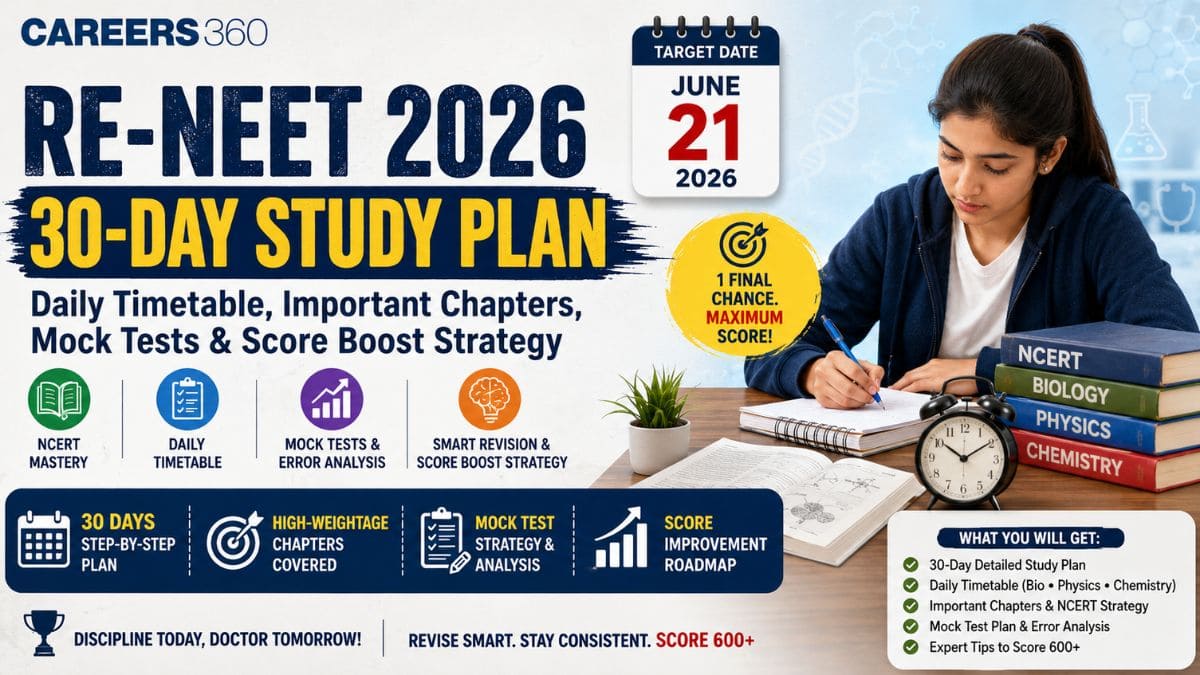
Re-NEET 2026 30-Day Study Plan PDF: The Re-NEET 2026 exam is scheduled for June 21, 2026. With just 30 days left for the NEET UG re-exam 2026, lakhs of aspirants now face one final opportunity to improve their NEET rank, recover from previous mistakes, and secure a medical seat. The right 30-day strategy can significantly boost scores through smarter revision, mock tests, and NCERT mastery.
Check now: Will Re-NEET 2026 Be Easier or Harder
The real challenge in the final month is improving accuracy, avoiding negative marking, and revising the NCERT textbooks effectively. Students who use these remaining days until the RE-NEET 2026 Exam often improve their scores significantly through consistent revision and practice rather than learning topics that are completely new.
The Re-NEET Paper 2026 highlights is helpful for students who wish to understand the expected exam pattern, question difficulty level, and important Re-NEET Exam updates.
Feature | Details |
Exam Name | Re NEET UG 2026 |
Conducting Body | National Testing Agency (NTA) |
Current Exam Status | Re-NEET Scheduled Following Official Re-Examination Notice |
Re NEET Exam Date | June 21, 2026 |
Exam Mode | Offline |
3 Hours 15 Minutes | |
Total Questions | 180 |
Total Marks | 720 |
Main Subjects | Physics, Chemistry, Biology |
Only those candidates who have registered earlier and appeared for the NEET UG 2026 exam are eligible for the Re-NEET exam. Check the official NTA notification for your specific eligibility category.
General eligibility criteria remain the same as NEET UG:
Age: 17 years as of December 31, 2026
Qualification: Class 12 with Physics, Chemistry, Biology/Biotechnology, and English
No upper age limit
Get Job Ready in Healthcare | Employability-Focused Programs
Get expert advice on college selection, admission chances, and career path in a personalized counselling session.
This 30-day study plan is divided into four important phases: Foundation reset, High-weightage revision, Mock test practice, and final revision sprint. Each phase is designed with a specific goal to help the students improve their preparation step by step before the Re-NEET 2026 exam. Completing each phase properly will help build confidence and improve accuracy for the exam on June 21.
The first week of the Re-NEET 2026 preparation plan should focus on understanding your current performance level and revising important basic concepts. Use this week to identify the weak areas and improve them before the June 21 exam.
Day 1: Take a full-length mock test. Do not check the answer key until you finish the test.
Day 2: Analyse the mock carefully. List every wrong answer subject and chapter-wise. Prepare those topics more thoroughly for the next remaining days.
Day 3-7: Start studying Biology from NCERT now. Practice high-weightage topics. Spend at least 4 hours on Biology daily. Use the remaining 4 hours on Physics and Chemistry.
Re-NEET 2026 preparation in the final month should focus heavily on high-weightage chapters that consistently contribute the maximum number of questions in Re-exams. Instead of revising the full syllabus equally, aspirants can improve scores faster by prioritising chapters with stronger historical weightage across Biology, Physics, and Chemistry.
Based on previous NEET trends, re-exam patterns, and rapid revision efficiency, certain chapters offer better score potential due to repeated concepts, NCERT dominance, and question frequency. Focusing on these chapters can help students maximise marks, improve revision speed, and reduce unnecessary syllabus overload during the final 30 days.
Biology remains the highest scoring section and should receive maximum revision priority.
Human Physiology
Genetics and Evolution
Ecology
Biotechnology
Reproduction
Plant Physiology
Cell Structure and Cell Division
Biomolecules
Human Health and Disease
Physics preparation should prioritise formula-heavy and repeatedly tested chapters.
Current Electricity
Electrostatics
Optics
Semiconductor Electronics
Modern Physics
Units and Dimensions
Oscillations and Waves
Gravitation
Magnetism
Aspirants can also practice further with the Re NEET Physics sample paper for better preparation.
Chemistry often becomes rank-defining through accuracy and conceptual precision.
Coordination Compounds
p-Block Elements
Biomolecules
Chemical Bonding
Thermodynamics
Equilibrium
Aldehydes, Ketones, and Carboxylic Acids
Electrochemistry
Prioritise NCERT line-by-line for Biology and Inorganic Chemistry
Practice formula sheets daily for Physics
Revise PYQs chapter-wise
Solve assertion-reason and statement-based questions
Focus more on accuracy than attempting new topics
Students aiming for major score improvement in Re-NEET 2026 should first secure these high-yield chapters before expanding into lower-weightage topics.
Detailed subject-wise chapter breakdown: Re-NEET 2026 Important Chapters, Difficulty & NCERT Strategy
This week should be for the purpose of practice only. Give a full-length NEET mock test and analyse each mistake you are making. Mock tests not only help improve speed but also build confidence before the Re-NEET 2026 exam.
How to give a mock test:
Start your test with a timer set for 3 hrs and 20 minutes to match the exact time setting as the NEET UG exam.
Avoid checking answers immediately.
Check your answers honestly.
Spend at least 30 minutes going through every wrong answer.
Write down each wrong answer in your mistake log copy.
Days 15–17: During these days, attempt the NEET 2026 Mock Test Series and review them deeply.
Days 18–19: Revise the full NCERT for Biology. Revise important Physics formulas and read each chemistry exception and naming reaction carefully.
Days 20–21: Allot these days for chapter-wise practice for the weak chapters. Do not start anything new, just revise what you already knew earlier.
Week 4 should focus only on revision and practice. Avoid starting any new chapter during this week. Use short notes, flash cards, formulas, and important NCERT points from the high-weightage chapters. Revise NEET Important formulas, and named reactions from chemistry.
Given below is a well-structured 30-day plan to help NEET 2026 aspirants manage revision, mock tests, and important topics more effectively during the final stage of preparation.
NEET 2026 30-Day Study Plan PDF: Day-Wise Timetable, Revision Strategy & Mock Plan |
Use this timetable as your daily practice blueprint for getting ready to score well in the Re-NEET 2026 exam.
Phase | Days | Biology | Physics | Chemistry | Daily Study Hours |
Foundation Revision | 1–7 | Cell Biology, Biomolecules, Diversity in the Living World | Mechanics, Units and Dimensions | Mole Concept, Atomic Structure, Basic Principles of Organic Chemistry | 8–9 hrs |
High-Weightage Revision | 8–14 | Human Physiology, Genetics, Ecology | Electrostatics, Optics, Semiconductor Electronics | Coordination Compounds, p-Block Elements, Organic Reactions | 9–10 hrs |
Mock Test Phase | 15–21 | NCERT Biology Revision + NEET PYQ Chapterwise Practice | Modern Physics, Oscillations and Waves | Organic Chemistry Revision, Biomolecules | 10 hrs + 1 Mock Test |
Final Quick Revision | 22–30 | Flashcards, Diagrams, and Important NCERT Points | Formula Revision | Named Reactions, Periodic Trends | Exam-like Practice |
Students often underestimate how much focused revision can improve NEET scores in the final month. Based on previous topper trends and mock performance:
400–500 scorers can realistically improve to 550+
550–620 scorers can push toward 650+
650+ scorers can optimise rank through precision, accuracy, and reduced negative marking
The key is strategic revision, NCERT mastery, mock analysis, and elimination efficiency rather than learning completely new concepts.
Follow these strategies recommended by the experts to score 600+ marks in the Re-NEET 2026 exam.
Tip 1: Study NCERT First: Complete NCERT first before using any reference books. Read all NEET important diagrams, tables, examples, and points carefully. After NCERT, you can practice questions from books like MTG Fingertips or DC Pandey. For chemistry, use the NCERT mainly. While for Physics, revise the NCERT concepts along with HC Verma.
Tip 2: Focus More on High-Weightage Chapters: Spend more time on chapters that carry more marks in NEET UG. Topics like Human Physiology and Genetics are very important from a weightage point of view in Biology. For Physics, units like Modern physics should be prepared. Balance your NEET Re exam preparation in all three subjects.
Tip 3: Use Smart Elimination During the Exam:
Learn to use elimination techniques properly. Know how you can remove two options and be sure about the answer.
You do not need multiple books for preparation. Use a few but reliable resources to score well.
Subject | Primary Resource | Supplementary Resource |
Biology | NCERT Class 11 + 12 (mandatory) | MTG Fingertips Biology |
Physics | NCERT Class 11 + 12 | HC Verma Concepts of Physics (Vol 1 + 2) |
Chemistry | NCERT Class 11 + 12 | VK Jaiswal (Inorganic) + MS Chouhan (Organic) |
Re-NEET 2026 offers aspirants one final chance to maximise performance, correct mistakes, and secure a stronger NEET rank. Students who remain disciplined, prioritise NCERT, analyse mocks, and revise strategically can significantly improve outcomes before June 21.
Frequently Asked Questions (FAQs)
Students should attempt at least 3–4 full-length mock tests before the exam along with a detailed analysis.
An error notebook helps students track repeated mistakes and revise weak concepts before the exam.
Students should attempt only those questions where they can eliminate incorrect options confidently.

On Question asked by student community
Hello Savi
Please check the link below:
Hope it helps.
Hello, some B.Sc Nursing colleges may offer admission without NEET, but the admission process depends on the college and its eligibility rules. You can find colleges offering B.Sc Nursing admission without NEET here: https://medicine.careers360.com/articles/bsc-nursing-admission-without-neet
Hello, you can pursue BPT in Kerala without NEET UG. Admission is generally based on the LBS Centre rank list and the applicable admission process. You can check BPT colleges in Kerala and their details here: https://medicine.careers360.com/colleges/list-of-bpt-in-physiotherapy-colleges-in-kerala
Hello Student,
If you are looking for information about NEET PG 2025 DNB seat allotment and the fees payable at the allotted college or hospital, DNB seats are allotted through the respective counselling process based on your rank, category, choice of speciality, and seat availability.
For the 2025 session, the
Dear Student, with a NEET PG 2026 rank of 6,600 in the EWS category, your options should be assessed using the relevant counselling year's college-wise closing ranks, category-wise seats and counselling round. Please also confirm whether you are applying through the applicable All India counselling route or another quota. That
the product 'P' will be ,


| Column A | Column B |
| A |
a) Organisation of cellular contents and further cell growth. |
| B |
b) Leads to formation of two daughter cells. |
| C |
c) Cell grows physically and increase volume proteins,organells. |
| D |
d) synthesis and replication of DNA. |
Match the correct option as per the process shown in the
0.16 g of dibasic acid required 25 ml of decinormal solution for complete neutralisation. The modecular weight of the acid will be
32
64
128
256
0xone is

Know possible Govt/Private MBBS/BDS Colleges based on your NEET rank
College Predictors Webinars One to One Counselling Regular Updates Medical Almanac
Get Job Ready in Healthcare | Employability-Focused Programs
Ranked among the top Dental Colleges for 7 consecutive years by India Today poll
Ranked #19 by NIRF, NAAC A++ Accredited | Recognized by dental council of India