SRM Kattankulathur Dental College and Hospital, Kattankulathur
Ranked #19 by NIRF, NAAC A++ Accredited | Recognized by dental council of India


If you want to become a doctor, it is important that you get a good rank in the National Eligibility cum Entrance Test (NEET) for undergraduate (UG) admissions to medical courses. And for this, you need to master all the subjects (Physics, Chemistry and Biology) included in the NEET UG syllabus. A good grip on Physics is crucial as 25% of the questions in the NEET paper is from the subject. So, how well you prepare for Physics is crucial in deciding your rank in the NEET exam, which is conducted annually.
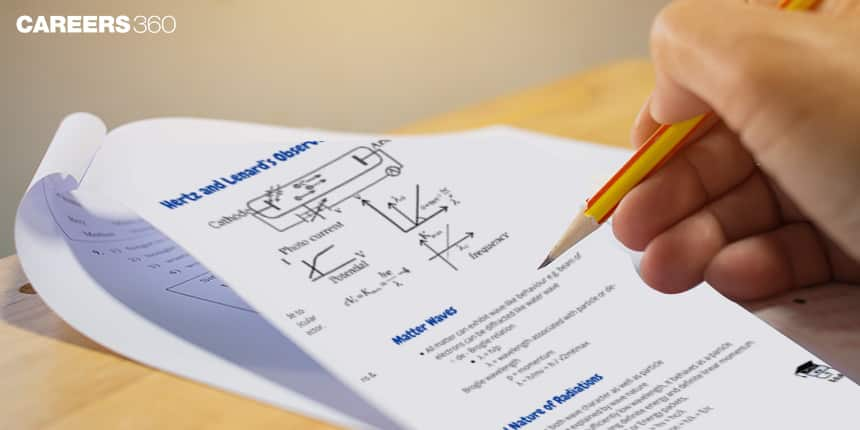
Knowing the important topics from each chapter will be quite useful in your preparation. Here is an analysis of the previous five years' NEET questions from the Class 12 NCERT chapter, Dual Nature Of Matter And Radiation. In the Last five years of NEET paper, a total of 9 questions were asked from the Class 12 NCERT chapter, Dual Nature Of Matter And Radiation.
Topic | Number Of Questions |
Einstein’s Photoelectric Equation | 3 |
de-Broglie Wavelength | 3 |
Concept of Electron Volt | 1 |
Energy of Photon | 1 |
Intensity of Light | 1 |
The above table makes it clear that Einstein's Photoelectric Equation and the de-Broglie Wavelength are two important topics of the chapter, Dual Nature Of Matter And Radiation. Let us get a brief idea of these concepts and the NEET questions related to them.
Get expert advice on college selection, admission chances, and career path in a personalized counselling session.
The photoelectric equation is given by -
Kinetic Energy (K.E) of the photo-electrons = (Energy obtained from the Photon) – (The energy used to escape the metallic surface).
KE=h?-ɸ
ɸ=h?0
The energy used to escape the metallic surface is known as the work function (ɸ). Here ?0 is the threshold frequency.
The photoelectric threshold wavelength of silver is 3250 x 10-10 m. The velocity of the electron ejected from a silver surface by the ultraviolet light of wavelength 2536 x 10-10 m is:
(Given h = 4.14 x 10⁻¹⁵ eVs and c = 3 x 10⁸ ms-1)
Solution
Here the wavelengths are given.

Therefore the photoelectric equation can be written as
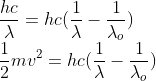
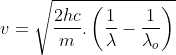
Given
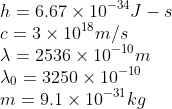
Substituting the values the answer is

When the light of frequency 2?0 (where ?0 is threshold frequency), is incident on a metal plate, the maximum velocity of electrons emitted is ?1. When the frequency of the incident radiation is increased to 5?0, the maximum velocity of electrons emitted from the same plate is ?2. The ratio of ?1 to ?2 is
Solution
From the Einstein equation

Initially

Finally

 or
or

An electromagnetic wave of wavelength λ is incident on a photosensitive surface of negligible work function. If 'm' mass is of photoelectron emitted from the surface has de-Broglie wavelength λd then:
Solution
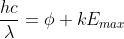
Momentum P = h/λd where λd is the de-Broglie wavelength, work function ɸ=0(Given)
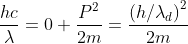
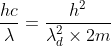
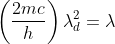
The de-Broglie wavelength of electron λe is given by




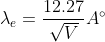
The de Broglie Wavelength Associated With Charged Particle
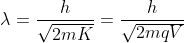
Where K is the Kinetic Energy, m is the mass of the particle, q is the charge of the particle and V is the potential difference.
Recommended Video-
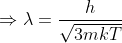
The de-Broglie wavelength of a neutron in thermal equilibrium with heavy water at a temperature T (Kelvin) and mass m, is
Solution
Kinetic energy of the neutron in thermal equilibrium with heavy water is-

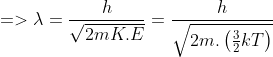
Here K.E is the Kinetic Energy
An electron of mass m with an initial velocity
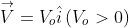
enters an electric field

at t = 0 . If  is its de-Broglie wavelength initially, then its de-Broglie wavelength at time t is
Options

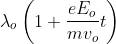


Solution



At time t the magnitude of the velocity
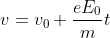
Momentum
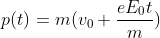
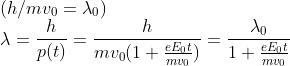
So option C is the right answer.
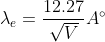
An electron is accelerated through a potential difference of 10000 V . Its de Broglie wavelength is

Solution
Use the equation-

In the last 5 years’ (2017-2021) NEET papers, 9 questions were asked and out of these 6 were from the topics de Broglie Wavelength and Einstein's Photoelectric Equation. That is, 66.67% of questions from Dual Nature were from these two topics.

On Question asked by student community
Hello Chetan,
Here are the links you asked for. I hope they serve your purpose.
Hello Suma,
Here are the links you asked for. I hope they serve your purpose.
Hello Bhanuday,
Here are the links you requested. I hope you find them helpful.
Hello Savi
Please check the link below:
Hope it helps.
Hello, for AP NEET PG Category C seats, NRI documents are generally required if you are applying under the NRI quota, and eligibility depends on the applicable counselling rules. The fee payment currency and procedure should be confirmed from the current Dr. NTRUHS notification at its official website drntr.uhsap.in.
the product 'P' will be ,


| Column A | Column B |
| A |
a) Organisation of cellular contents and further cell growth. |
| B |
b) Leads to formation of two daughter cells. |
| C |
c) Cell grows physically and increase volume proteins,organells. |
| D |
d) synthesis and replication of DNA. |
Match the correct option as per the process shown in the
0.16 g of dibasic acid required 25 ml of decinormal solution for complete neutralisation. The modecular weight of the acid will be
32
64
128
256
0xone is

Ranked #19 by NIRF, NAAC A++ Accredited | Recognized by dental council of India
Ranked among the top Dental Colleges for 7 consecutive years by India Today poll