Emversity Allied Health Programs
Get Job Ready in Healthcare | Employability-Focused Programs


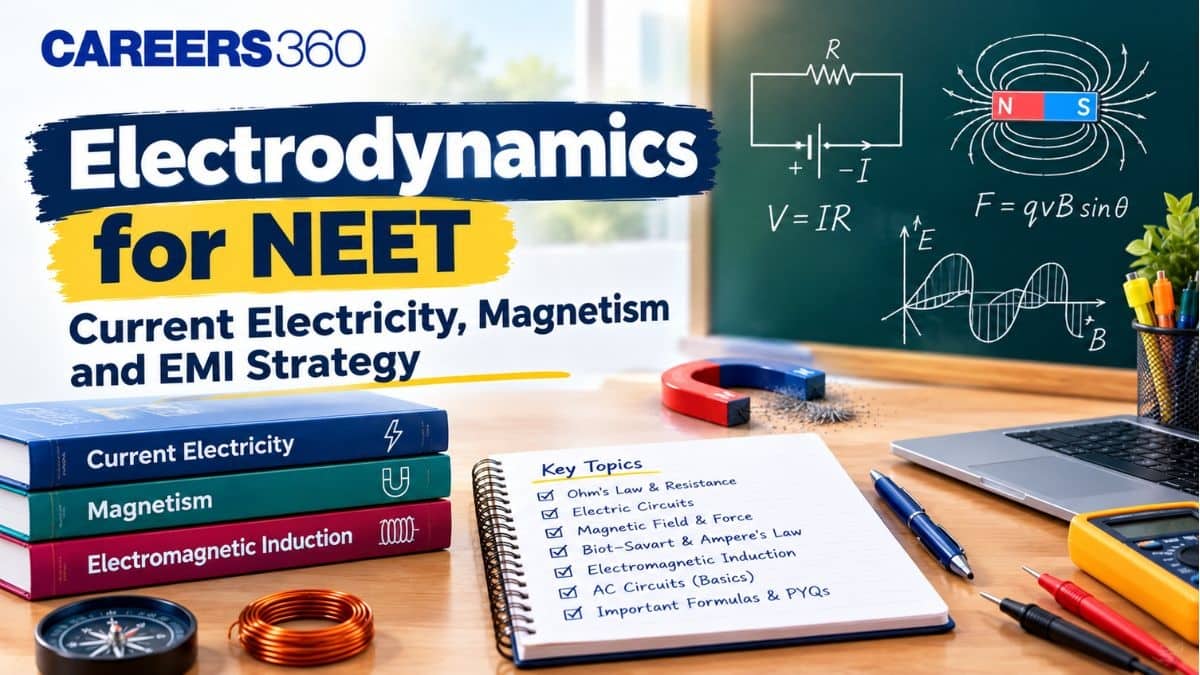
Electrodynamics for NEET: Current Electricity, Magnetic Effects of Current and Magnetism, and Electromagnetic Induction and Alternating Currents are usually taught as three separate Class 12 chapters. For a NEET aspirant, they chapters are one continuous block of physics. A moving charge sets up a magnetic field, that field interacting with a conductor produces a force or a torque, and a changing field induces a current, which brings the discussion straight back to circuits. Treating them as a single unit rather than three isolated chapters is one of the more practical shifts a candidate can make while preparing for NEET (UG). It helps students understand how questions are frequently designed: a Wheatstone bridge numerical that folds in Kirchhoff's laws, or a coil-and-magnet problem that expects Lenz's law and the motional EMF equation.
This Story also Contains
In a five-year trend analysis of NEET 2027 high-weightage chapters in Physics, Careers360 found Current Electricity to be the single most consistent question-producing chapter in the section. Moving Charges and Magnetism follows close behind. The unit structure itself has held steady: the NEET syllabus still lists Current Electricity, Magnetic Effects of Current and Magnetism, and Electromagnetic Induction and Alternating Currents as consecutive units within the Class 12 Physics syllabus. This is a continuity explicitly confirmed for the 2026 cycle when the NMC clarified there was no addition or reduction to the NEET UG syllabus.
Physics as a section carries 180 of the 720 total marks in NEET, a quarter of the paper by design, and within that section electrodynamics is not an optional speciality the way semiconductor devices can sometimes feel like one. A candidate who has not prepared Ohm's law, series-parallel resistance networks, the Biot-Savart and Ampere's circuital laws, and Faraday's and Lenz's laws well will find that weakness resurfacing across several differently worded questions rather than just one. These concepts and ideas are the building blocks for the rest of Class 12 Physics.
Get Job Ready in Healthcare | Employability-Focused Programs
That interdependence is also why these chapters need a slightly different revision approach than other topics like thermodynamics. So, rather than closing the book on Current Electricity once its numericals feel comfortable, it is worth revisiting the chapter after finishing Magnetism and EMI. Specifically, to notice where a circuit-based question has quietly used a magnetism concept, or where an EMI numerical is really just a different application of the resistance and power formulas from the earlier chapter.
Reading through the chapter-wise Physics weightage data Careers360 has compiled, alongside the do-or-die chapters for NEET that consistently name these three chapters among the highest-priority topics, gives a reasonably reliable sense of where electrodynamics sits in the overall preparation hierarchy.
Get expert advice on college selection, admission chances, and career path in a personalized counselling session.
Current Electricity begins with Ohm's law and the idea of resistivity, but the questions rarely stop there. NEET numericals in this chapter typically combine two or three ideas at once — a resistor network that needs series-parallel reduction before Ohm's law can even be applied, or a temperature-dependence question that expects the resistivity-temperature relationship alongside a basic circuit calculation.
Three specific sub-topics carry disproportionate weight in how often they appear:
Kirchhoff's laws. The junction rule (conservation of charge at a node) and the loop rule (conservation of energy around a closed loop) are the tools behind almost every multi-loop circuit question. Candidates who try to solve these with simple series-parallel reduction alone tend to get stuck the moment a circuit has more than one EMF source.
The Wheatstone bridge and meter bridge. The balance condition, where the bridge carries no current through the galvanometer arm when P/Q equals R/S, is tested both as a direct numerical and as the underlying principle behind the meter bridge experiment for finding an unknown resistance.
The potentiometer. Because a potentiometer draws no current from the circuit being measured at the balance point, it measures EMF more accurately than a voltmeter — a conceptual point NEET likes to test directly, alongside its use in comparing EMFs of two cells and measuring internal resistance.
A quick but often-skipped detail: internal resistance and terminal voltage questions are frequently paired with the potentiometer or with a simple series circuit, and mixing up EMF (the total electromotive force of the cell) with terminal voltage (EMF minus the voltage drop across internal resistance) is one of the more common ways marks are lost here, since both variants can look identical if read too quickly.
This chapter's core content, the Biot-Savart law and Ampere's circuital law, exists to answer one question in different forms: given a current-carrying conductor of some shape, what magnetic field does it produce at a given point? NEET tests this with a small, repeating set of standard geometries — a long straight wire, a circular loop at its centre and on its axis, and a solenoid — and expects the field expressions for each to be recalled quickly rather than derived from scratch under time pressure.
The second half of the chapter shifts from field production to field effects: the force on a moving charge (the Lorentz force, F = qv × B), the force on a current-carrying conductor, and the force between two parallel current-carrying wires, which is also the basis for the formal definition of the ampere. Questions on a charged particle moving in a uniform magnetic field, tracing out a circular or helical path depending on the angle between velocity and field, are a recurring type, as are torque-on-a-current-loop questions that lead into how a moving coil galvanometer is built and then converted into an ammeter (using a low-resistance shunt) or a voltmeter (using a high-resistance multiplier).
Magnetism proper — the bar magnet treated as an equivalent solenoid, magnetic dipole moment, and Earth's magnetic elements (declination, dip, and the horizontal component of Earth's field) — tends to be conceptually lighter but still shows up reliably enough that skipping it to spend more time on numerical-heavy topics is a poor trade. Careers360's chapter-level analysis places Moving Charges and Magnetism among the top few highest-weightage Physics chapters in recent papers, on the same tier as Oscillations, which is worth keeping in mind when deciding how much revision time this section earns relative to chapters that feel more calculation-intensive.
Electromagnetic induction is where the electrodynamics block closes the loop, literally: a changing magnetic flux through a circuit induces an EMF, as described by Faraday's laws, and Lenz's law fixes the direction of that induced current by insisting it always opposes the very change that produced it — a direct consequence of energy conservation that NEET tests both as a standalone concept question and embedded inside numericals.
Motional EMF (e = Bvl, for a rod moving through a magnetic field) is one of the more frequently tested calculation types in this chapter, often combined with a force or power calculation to check whether a candidate understands that the induced current itself creates a retarding force on the moving conductor — another expression of Lenz's law in a slightly disguised form. Self-inductance and mutual inductance, along with the energy stored in an inductor, round out the DC side of the chapter.
The alternating current portion is where this chapter connects most directly back to Current Electricity. Peak and RMS values, inductive and capacitive reactance, and the impedance of a series LCR circuit are tested individually and in combination, with the resonance condition — where inductive reactance equals capacitive reactance, allowing maximum current to flow at the resonant frequency — a particularly reliable numerical type. Power in an AC circuit, governed by the power factor (the cosine of the phase angle between voltage and current), and the working principle of an ideal transformer, where the voltage and turns ratio mirror the inverse current ratio, complete the high-yield areas of this chapter. In a dedicated PYQ analysis of Electromagnetic Induction and Alternating Currents, Careers360 found this chapter accounts for a meaningful and fairly stable weightage of total Physics marks across recent papers. It reinforces that it deserves the same systematic treatment as Current Electricity rather than being treated as a shorter, lower-priority chapter simply because it comes later in the syllabus.
The clearest sign that these three chapters should be revised together, rather than in sequence and then set aside, is how often a single NEET question is based on these topics. A circuit containing an inductor or a capacitor requires Current Electricity's circuit-reduction skills and EMI's reactance formulas at the same time. A question about the force on a current loop placed in a magnetic field, or about a rod sliding on rails inside a magnetic field, sits squarely between Magnetism and EMI, since it needs both the force expression from one chapter and the motional EMF expression from the other. Even the moving coil galvanometer, taught within Magnetism, is really a Current Electricity application once the question turns to converting it into an ammeter or voltmeter.
This is also where multi-concept, integrative questions tend to concentrate, and it is worth deliberately practising a batch of previous year questions from this specific overlap zone rather than assuming chapter-wise practice alone will surface them. The NEET PYQ chapterwise resource is useful here precisely because working through a chapter's previous year questions in sequence tends to reveal, fairly quickly, which of its questions are actually self-contained and which ones lean on a neighbouring chapter.
A practical way to sequence these topics is to build Current Electricity first, since its concepts (Ohm's law, Kirchhoff's laws, circuit reduction) are reused throughout Magnetism and EMI rather than the other way around.
Magnetism follows naturally, given how directly the Biot-Savart law and the Lorentz force feed into EMI's treatment of motional EMF and induced current direction.
In the last, EMI, because it pulls together circuit analysis from the first chapter and field concepts from the second, so attempting it too early usually means re-learning parts of both.
Formula recall matters more here than in most other Physics chapters. This section contains many closely related expressions. Such as magnetic fields due to different current geometries, several force expressions, and multiple AC quantities that are easy to confuse under time pressure. So, the NEET Physics formula sheet or a chapter-specific one like the Modern Physics formula sheet are useful for keeping formula-recall habits consistent across chapters, even outside electrodynamics.
Numerical practice itself should draw directly from previous year questions rather than generic problem sets, since NEET's electrodynamics numericals tend to follow a fairly narrow set of recurring structures once a candidate has seen enough of them.
Careers360's Top 50 Physics Numericals compilation and the Top 10 Physics formulas piece are both built around this same idea — that a comparatively small set of formulas and question types accounts for a large weightage of what actually gets asked. Once individual chapters feel solid, folding electrodynamics questions into full-length mock tests is what confirms whether the concepts hold up under the same time pressure as the real exam.
Also Read:
Frequently Asked Questions (FAQs)
Because NEET frequently frames questions that require more than one of these chapters at once.
Within Current Electricity, Kirchhoff's laws, the Wheatstone bridge and the potentiometer repeat often. Within Magnetism, the standard field geometries (straight wire, circular loop, solenoid) and the moving coil galvanometer's conversion into an ammeter or voltmeter are frequently tested. Within EMI, motional EMF, the resonance condition in a series LCR circuit, and transformer principles are the areas that appear most consistently across previous year papers.
No. NTA does not release an official chapter-wise weightage breakdown for NEET. Figures describing how often a chapter has appeared in recent papers, including those referenced in this article, come from Careers360's own analysis of previous year question papers.

On Question asked by student community
Hello Savi
Please check the link below:
Hope it helps.
Hello, for AP NEET PG Category C seats, NRI documents are generally required if you are applying under the NRI quota, and eligibility depends on the applicable counselling rules. The fee payment currency and procedure should be confirmed from the current Dr. NTRUHS notification at its official website drntr.uhsap.in.
Hello, the NEET PG stipend at Parul University depends on the postgraduate course, academic year and applicable university policies.
Hello, some B.Sc Nursing colleges may offer admission without NEET, but the admission process depends on the college and its eligibility rules. You can find colleges offering B.Sc Nursing admission without NEET here: https://medicine.careers360.com/articles/bsc-nursing-admission-without-neet
Hello, you can pursue BPT in Kerala without NEET UG. Admission is generally based on the LBS Centre rank list and the applicable admission process. You can check BPT colleges in Kerala and their details here: https://medicine.careers360.com/colleges/list-of-bpt-in-physiotherapy-colleges-in-kerala
the product 'P' will be ,


| Column A | Column B |
| A |
a) Organisation of cellular contents and further cell growth. |
| B |
b) Leads to formation of two daughter cells. |
| C |
c) Cell grows physically and increase volume proteins,organells. |
| D |
d) synthesis and replication of DNA. |
Match the correct option as per the process shown in the
0.16 g of dibasic acid required 25 ml of decinormal solution for complete neutralisation. The modecular weight of the acid will be
32
64
128
256
0xone is

Know possible Govt/Private MBBS/BDS Colleges based on your NEET rank
College Predictors Webinars One to One Counselling Regular Updates Medical Almanac
Get Job Ready in Healthcare | Employability-Focused Programs
Ranked among the top Dental Colleges for 7 consecutive years by India Today poll
Ranked #19 by NIRF, NAAC A++ Accredited | Recognized by dental council of India