SRM Kattankulathur Dental College and Hospital, Kattankulathur
Ranked #19 by NIRF, NAAC A++ Accredited | Recognized by dental council of India


The Medical Counselling Committee (MCC) has now changed the NRI quota eligibility for MBBS and BDS admissions through NEET 2025. A new priority-based system is in place for the NRI quota seat allotment. This step is to ensure that students with genuine NRI status are given preference in NEET counselling over others.
This Story also Contains

MCC has two types of NRI quota seats in NEET counselling: one for the genuine NRIs and one sponsored, where Indian students are sponsored by their NRI relatives for the MBBS or BDS admissions.
The NRI quota in NEET UG is one of the most widely misused ones in medical admissions, where Indian students with low ranks and a low possibility of a medical seat take the help of the NRI quota system to avail seats. All they need to do is get an NRI sponsor who is a relative and use their status to get a seat. Till last year, NRI quota sponsorship was only by first degree relatives.
To allow genuine NRIs get the first shot at admissions, MCC has come up with a new priority system. The details of what the new rule means, who will benefit and how it could change the future of NRI admissions in India is elaborated below.
Get expert advice on college selection, admission chances, and career path in a personalized counselling session.
MCC has introduced a two-tier priority system for NEET 2025 seat allotment under the NRI category in the UG medical counselling. As per the notice, students will be grouped into two priority levels.
Candidates who are NRIs themselves
Children of NRIs
Ranked #19 by NIRF, NAAC A++ Accredited | Recognized by dental council of India
Special Scholarship for Students from Goa (Get an exclusive scholarship of ₹20,000 if you're a Goa-based student) | Bringing Parul Education Trust's 30-year Education Legacy to Goa
These students will be given the first preference for seat allotment under the NRI quota.
First degree relatives of NRIs (like grandparents, siblings, uncles, aunts)
Second degree relatives (cousins)
Priority 2 candidates will only be considered for any vacant seats after all Priority 1 candidates have been allotted seats.
Check MCC notice for the same
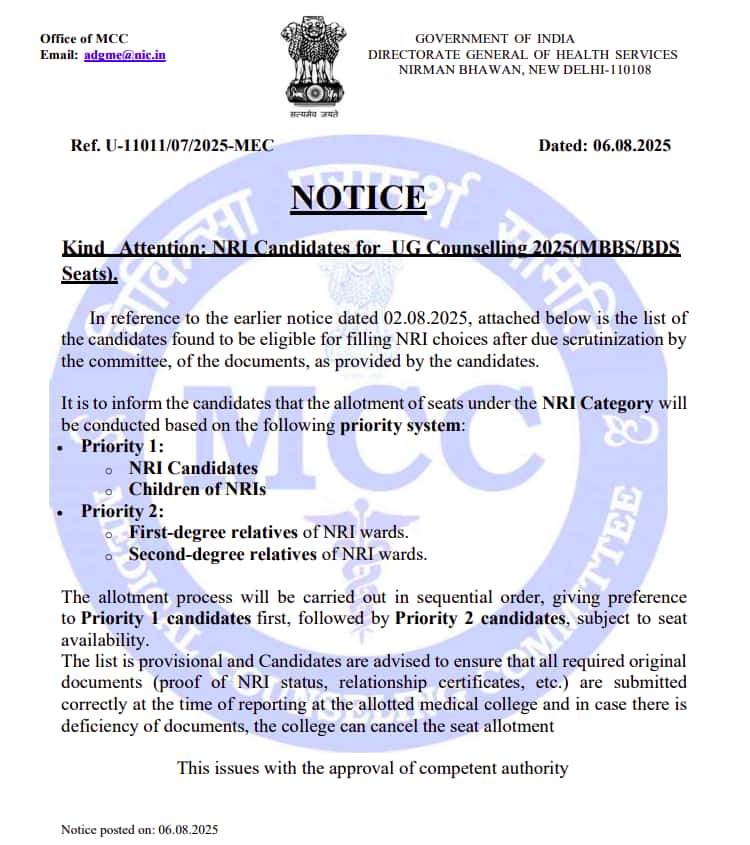
Earlier, NRI quota was used up by students with low NEET ranks and a remote probability of seat allotment in any other quota. Sponsorship by an NRI relative was just enough, though the clause did specify first degree relatives. However, many students have blatantly misused this by using NRI sponsorship letters from distant relatives to secure a seat despite lower NEET scores. There was no means of verifying the claims of the degree of relationship.
For example, a student in India could claim they were eligible for an NRI seat just because a relative living in another country agreed to pay their fees. In many cases, these were just a front where the student actually paid the fees through the NRI relative and not actual sponsorship. Seats were also allotted despite no strong family connection, all on the basis of the NRI documents submitted.
The priority system aims to set this anomaly right. MCC has set clear guidelines on who gets the first preference and the actual relationship. This year’s new feature marks the sponsorship by second degree relatives like cousins, etc, at the second priority level.
So genuine NRIs or children/ wards of NRIs get the first chance for admissions, followed by sponsorship by first degree relatives and then second degree relatives.
With this new notice, the MCC has made one thing clear that there will be no loosely defined NRI quota admissions anymore. The NRI quota in NEET admissions has always been a topic of discussion. For years, there has been confusion over who exactly qualifies, resulting in a lot of misuse.
Going forward, candidates will need to submit clear, valid documents to prove their eligibility. Colleges have been given the power to cancel seats if papers are incomplete or unclear. This change will likely be adopted by NEET UG state counselling authorities as well. Maharashtra and Odisha have already implemented this and the rest are considering the presence of a common rule for NRI quota admissions across India.

On Question asked by student community
Hello Students,
For the NEET UG 2026 Question Paper PDF with Answer Key and Solutions, refer to the article below:
https://medicine.careers360.com/articles/neet-previous-year-question-paper-with-solution
Hello Student,
You can check the resource provided below:
Download NEET Previous 10 Years Question Papers with Solutions PDF
You can also check the NEET 2026 question paper with solutions
Hope this helps!
Hello Chetan,
Here are the links you asked for. I hope they serve your purpose.
Hello Suma,
Here are the links you asked for. I hope they serve your purpose.
Hello Bhanuday,
Here are the links you requested. I hope you find them helpful.
the product 'P' will be ,


| Column A | Column B |
| A |
a) Organisation of cellular contents and further cell growth. |
| B |
b) Leads to formation of two daughter cells. |
| C |
c) Cell grows physically and increase volume proteins,organells. |
| D |
d) synthesis and replication of DNA. |
Match the correct option as per the process shown in the
0.16 g of dibasic acid required 25 ml of decinormal solution for complete neutralisation. The modecular weight of the acid will be
32
64
128
256
0xone is

Ranked #19 by NIRF, NAAC A++ Accredited | Recognized by dental council of India
Special Scholarship for Students from Goa (Get an exclusive scholarship of ₹20,000 if you're a Goa-based student) | Bringing Parul Education Trust's 30-year Education Legacy to Goa
Ranked among the top Dental Colleges for 7 consecutive years by India Today poll