Emversity Allied Health Programs
Get Job Ready in Healthcare | Employability-Focused Programs


The National Testing Agency (NTA) conducts the National Eligibility cum Entrance Test (NEET UG) annually for admission to MBBS, BDS, BAMS, BSMS, BUMS, and BHMS programmes across India. With NEET 2026 approaching, candidates who have completed their primary preparation must now shift focus from learning new concepts to consolidating what has already been studied. The final phase of preparation is not about expanding the syllabus — it is about reinforcing accuracy, recall speed, and examination temperament.
This Story also Contains
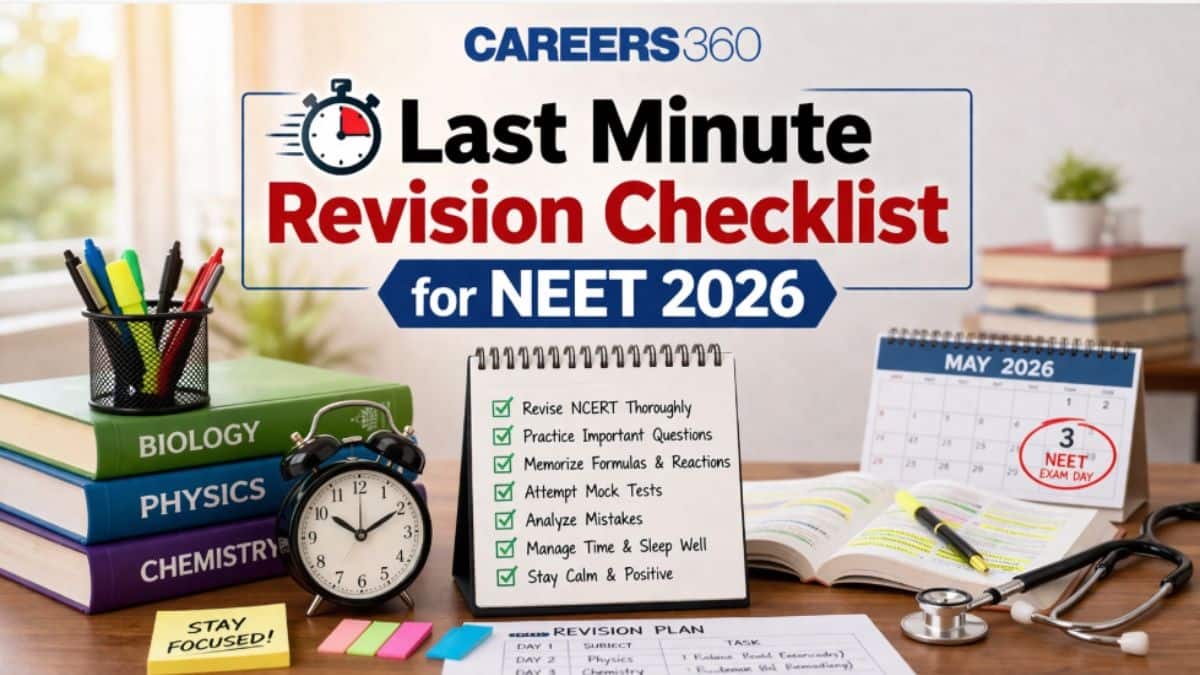
This article provides a detailed last minute revision checklist for NEET 2026, covering subject-wise high-priority topics, a structured 7-day revision timetable, mock test strategy, and a detailed exam day checklist. Candidates are advised to read this article in conjunction with the official NEET 2026 syllabus as notified by the National Medical Commission (NMC).
In the context of NEET UG preparation, the term 'last minute revision' broadly refers to the final 7 to 15 days before the exam. This phase is distinct from the final month of preparation, which typically involves completing pending topics and taking full-length mock tests. During the last 7 days of the NEET exam, the recommended approach involves:
Get Job Ready in Healthcare | Employability-Focused Programs
Consolidating NCERT-based concepts, particularly for Biology
Reviewing self-prepared notes, NEET formula sheets, and flashcards
Attempting at least one full-length mock test under simulated examination conditions
Analysing previous years' NEET question papers to identify high-frequency topic patterns
Avoiding the introduction of new topics or reference material
It is important for candidates to understand that revision at this stage should be selective, time-bound, and evidence-based - prioritising topics that carry maximum weightage in the NEET UG exam pattern.
Get expert advice on college selection, admission chances, and career path in a personalized counselling session.
Before proceeding with the revision checklist, candidates must be familiar with the NEET 2026 exam pattern as per the prevailing NMC-notified pattern.
NEET Exam Pattern
Subject | Number of Questions | Total Marks |
Physics | 45 | 180 |
Chemistry | 45 | 180 |
Biology (Botany + Zoology) | 90 | 360 |
Total | 180 | 720 |
Marking Scheme: +4 for each correct response; -1 for each incorrect response; 0 for unattempted questions.
Follow this subject-wise last-minute revision checklist for NEET 2026 to prioritise high-weightage topics, strengthen key concepts, and maximise accuracy in Biology, Physics, and Chemistry.
Biology remains the highest-weightage subject in NEET UG, contributing 50 per cent of the total marks. Analysis of NEET question papers from 2017 to 2025 consistently indicates that approximately 85 to 90 per cent of Biology questions are sourced directly from NCERT Class 11 and Class 12 textbooks, including NEET diagrams 2026, tables, and in-text examples. Candidates are strongly advised to complete a minimum of two full readings of the NCERT Biology textbooks during the last revision phase.
Class 11 Biology – High-Weightage Chapters for Revision
The following chapters from Class 11 Biology have demonstrated consistent representation in NEET UG question papers and must be prioritised during last minute revision:
The Living World and Biological Classification: Candidates should revise the five-kingdom classification system, salient features of each kingdom, and the basis of classification. Special attention should be given to distinguishing characteristics of Monera, Protista, Fungi, Plantae, and Animalia.
Plant Kingdom and Animal Kingdom: These two chapters collectively contribute 4 to 6 questions in most NEET examinations. Candidates must memorise the characteristic features of each division and phylum, along with standard examples. The alternation of generations in Bryophytes, Pteridophytes, Gymnosperms, and Angiosperms is a frequently examined concept.
Cell Structure and Function: The chapter 'Cell: The Unit of Life' requires thorough revision of organelle structure and function, differences between prokaryotic and eukaryotic cells, and the ultrastructure of the plasma membrane. The fluid mosaic model, semi-permeability, and osmosis-related concepts are commonly tested.
Biomolecules: Candidates should revise the structure and function of carbohydrates, proteins, lipids, and nucleic acids. Enzyme kinetics — including Michaelis-Menten kinetics, inhibition types, and the effect of temperature and pH — is a high-frequency examination topic.
Cell Division: Both mitosis and meiosis must be revised with reference to the sequence of stages, chromosomal behaviour at each stage, significance, and the differences between the two processes. The significance of meiosis in generating genetic variability through crossing over and independent assortment is frequently tested.
Plant Physiology (Photosynthesis, Respiration, Plant Growth): The mechanism of photosynthesis — including the light-dependent reactions (Z-scheme), the Calvin cycle (C3 pathway), C4 pathway (Hatch-Slack cycle), and CAM — must be revised thoroughly. For respiration, candidates should be familiar with glycolysis, the Krebs cycle, and the electron transport chain, including net ATP yield calculations. Plant growth regulators and their physiological roles should be revised from the NCERT tables and summary points.
Human Physiology (Class 11): Chapters on Breathing and Exchange of Gases, Body Fluids and Circulation, Excretory Products and Their Elimination, Locomotion and Movement, Neural Control and Coordination, and Chemical Coordination and Integration all carry significant weightage. Candidates must revise the structure-function relationships, associated hormones, regulatory mechanisms, and common disorders mentioned in NCERT.
Class 12 Biology – High-Weightage Chapters for Revision
Genetics and Molecular Biology: These chapters account for the single largest cluster of Biology questions in NEET UG, often contributing 14 to 18 questions in combination. Candidates must revise Mendel's laws and their exceptions (incomplete dominance, codominance, multiple allelism, polygenic inheritance, pleiotropy), chromosomal theory of inheritance, sex-linked inheritance, linkage and crossing over, sex determination mechanisms, and human genetic disorders including chromosomal abnormalities. For Molecular Biology, the key areas include: the Hershey-Chase experiment and Griffith's experiment, DNA structure (Watson-Crick model), semi-conservative replication (Meselson-Stahl experiment), enzymes involved in replication and transcription, translation (including post-translational modifications), lac operon, and the Human Genome Project.
Reproduction: Both Class 12 chapters — 'Sexual Reproduction in Flowering Plants' and 'Human Reproduction' — require careful revision. Key areas include microsporogenesis, megasporogenesis, pollination types, double fertilisation, seed and fruit development, gametogenesis in humans, the menstrual cycle (with hormonal regulation), fertilisation, implantation, foetal development, and parturition. Reproductive health, contraception methods, STDs, and amniocentesis are also commonly examined.
Evolution: Candidates should revise theories of origin of life, Darwin's theory of natural selection, evidence of evolution, Hardy-Weinberg principle and its conditions, and the stages of human evolution. This chapter typically contributes 3 to 4 questions.
Human Health and Disease: This chapter is a consistent source of 4 to 6 questions. Candidates must revise the life cycle of Plasmodium (malaria), the mechanism of HIV infection and AIDS progression, types of immunity (innate and adaptive), structure of antibodies, cancer types and causes, and the effects of drugs and alcohol on the human body.
Biotechnology: Both the chapters on Principles and Processes and Applications should be revised with reference to restriction enzymes and their role in rDNA technology, PCR, gel electrophoresis, expression vectors, Bt crops (Bt toxin mechanism), gene therapy, insulin production (Eli Lilly process), ELISA, and biosafety concerns (Biosafety Level designations).
Ecology: Chapters on Organisms and Populations, Ecosystem, Biodiversity and Conservation collectively contribute 12 to 15 questions. Candidates should revise population attributes and growth models (logistic and exponential), interspecific interactions (with examples), energy flow and ecological pyramids, types of biodiversity, biodiversity hotspots in India, in-situ and ex-situ conservation methods, including ozone depletion, eutrophication, and biomagnification.
The Chemistry section of NEET UG is subdivided into Physical, Organic, and Inorganic Chemistry. Unlike Biology, Chemistry requires both conceptual understanding and numerical problem-solving ability. During the last minute revision phase, candidates should focus on revisiting formulas, named reactions, and periodic trends rather than attempting new problem sets.
Physical Chemistry – Key Areas for Revision
Candidates should ensure they have revised the following areas: mole concept and stoichiometry (Some Basic Concepts of Chemistry), quantum mechanical model of the atom (Atomic Structure), Lewis structures and VSEPR theory (Chemical Bonding), ideal and real gas behaviour, gas laws and the kinetic molecular theory (States of Matter), thermodynamic functions and spontaneity criteria (Thermodynamics), equilibrium constants and their interrelationship, buffer solutions and the common ion effect (Equilibrium), electrochemical cells and the Nernst equation (Electrochemistry), integrated rate laws and the Arrhenius equation (Chemical Kinetics), Raoult's law and colligative properties including Van't Hoff factor (Solutions).
Inorganic Chemistry – Key Areas for Revision
The chapters on p-Block Elements (Class 12), d- and f-Block Elements, and Coordination Compounds are the most heavily tested areas of Inorganic Chemistry in NEET UG. Candidates must revise the oxoacids of nitrogen, phosphorus, sulphur, and halogens; the properties of interhalogen compounds and noble gas compounds; the electronic configurations of d-block elements and the basis of colour, paramagnetism, and variable valency; lanthanide contraction and its consequences; and the IUPAC nomenclature, Werner's theory, crystal field theory, types of isomerism (especially geometric and optical), and the stability of coordination compounds.
Organic Chemistry – Key Areas for Revision
General Organic Chemistry (GOC) forms the conceptual foundation for all organic chemistry questions and should be revised first. Candidates must be thorough with inductive, mesomeric, and hyperconjugation effects; stability of reaction intermediates (carbocations, carbanions, free radicals, carbenes); and the electronic effects governing product formation. Named reactions from Aldehydes, Ketones, and Carboxylic Acids (Cannizzaro, Aldol condensation, Clemmensen reduction, Wolf-Kishner reduction, Hell-Volhard-Zelinsky reaction, Rosenmund reduction), Amines (Sandmeyer reaction, Balz-Schiemann reaction, Hofmann bromamide degradation), and Haloalkanes (SN1 and SN2 mechanisms, Walden inversion) must be memorised along with reagents and reaction conditions. The Biomolecules chapter should be revised for direct factual questions, which are common in NEET.
Physics is widely regarded as the most discriminating subject in NEET UG and often determines the rank bracket of a candidate. During the last revision phase, emphasis should be placed on formula consolidation, concept application, and error reduction in numerical problems.
Class 11 Physics – Key Areas for Revision
Laws of Motion (including pseudo forces and friction), Work-Energy Theorem and conservation laws, Rotational Mechanics (moment of inertia, torque, rolling motion), Gravitation (orbital and escape velocity, Kepler's laws), Simple Harmonic Motion, and Waves (standing waves, beats) are consistently tested areas. Candidates should revise kinematic graphs carefully, as interpretation-based questions appear regularly.
Class 12 Physics – Key Areas for Revision
The following chapters carry the highest weightage in NEET Physics from Class 12: Electrostatics (Gauss's law applications, electric potential, capacitor combinations and energy), Current Electricity (Kirchhoff's laws, Wheatstone bridge, principle), Moving Charges and Magnetism (Biot-Savart law, Ampere's law, force between parallel conductors), Electromagnetic Induction and Alternating Current (Faraday's law, LCR resonance, transformers, power factor), Ray Optics and Optical Instruments (mirror and lens formula, total internal reflection, refraction through a prism, resolving power of optical instruments), Wave Optics (Young's double slit experiment, diffraction and the condition for minima, Brewster's angle), Dual Nature of Radiation and Matter (photoelectric effect equations, de Broglie wavelength, Davisson-Germer experiment), Atoms and Nuclei (Bohr's model, spectral series, radioactive decay law, half-life, binding energy per nucleon), and Semiconductor Electronics (p-n junction characteristics, half-wave and full-wave rectification, Zener diode as voltage regulator, transistor in CE configuration, Boolean algebra and logic gates).
Candidates are advised to maintain a dedicated formula revision sheet for Physics, which should be reviewed at the beginning of each study session during the final week.
The following schedule is recommended for candidates in the final 7 days before NEET 2026. It is based on expert guidance and analysis of strategies adopted by high-scoring candidates in previous years.
Day | Subject and Focus Area |
Day 1 | Biology – Class 12: Genetics, Principles of Inheritance, Molecular Basis of Inheritance, Biotechnology (Principles and Applications) |
Day 2 | Biology – Class 12: Reproduction, Evolution, Human Health and Disease, Ecology (all four chapters) |
Day 3 | Biology – Class 11: All chapters, with emphasis on Human Physiology, Plant Physiology, Cell Biology, and classification chapters |
Day 4 | Chemistry – Organic: GOC, Named reactions (Aldehydes to Amines), Biomolecules, Inorganic: Coordination Compounds, p-Block, d-f Block |
Day 5 | Physics – Class 12: Electrostatics, Current Electricity, Magnetism, EMI, AC Circuits, Optics, Modern Physics, Semiconductors |
Day 6 | Full-length mock test (3 hours 20 minutes, OMR simulation); post-test error analysis; revision of all incorrectly attempted questions |
Day 7 (Day Before Exam) | Light revision of formula sheets, NCERT diagrams, and error log only; no new topics; adequate sleep by 10:00 PM |
Important Note: Candidates should not deviate significantly from their established study routine during this phase. The brain functions more efficiently under familiar conditions. Any abrupt change in sleep pattern or study schedule in the final days may adversely affect retention and examination performance.
Mock tests and previous year papers play a crucial role in the final revision phase of NEET 2026, helping improve accuracy and identify weak areas.
Attempt 1 full-length NEET mock test between Day 4–Day 6 under strict exam conditions (3 hours + OMR practice)
Analyse every mistake and revise the related NCERT concept thoroughly
Avoid multiple mock tests in the last 2–3 days to prevent stress and burnout
Prioritise NEET previous year papers (2017–2025) to identify repeated and high-weightage topics
Solve NEET PYQs chapter-wise instead of using extra study material
Avoiding common mistakes in the final phase of NEET 2026 preparation is essential to maintain accuracy and maximise your score.
Do not start new topics or reference books in the last week; focus on revising what you already know
Avoid leaving topics incomplete - strengthen your prepared areas instead of covering everything
Do not ignore Inorganic Chemistry (Coordination Compounds, p-Block, d-Block) as they are high-scoring
Avoid irregular sleep schedules; aim for at least 7–8 hours of sleep daily
Limit excessive caffeine intake and overstudying (10–12+ hours), as it reduces efficiency and focus
Candidates are advised to ensure the following on the day of the NEET 2026 examination:
Documents Required:
NEET 2026 Admit Card (downloaded from the NTA official website; black and white printout is acceptable)
Valid government-issued photo identity proof (Aadhaar Card / Passport / Driving Licence / Voter ID)
Passport-size photographs as specified in the admit card instructions
Examination Centre Conduct:
Candidates should report to the examination centre at least 60 minutes before the commencement of the examination. Entry to the examination hall is typically closed 30 minutes before the start time.
Electronic devices, including mobile phones, smart watches, and Bluetooth accessories, are strictly prohibited inside the examination hall.
Candidates should carry a transparent water bottle and, if applicable, diabetes-related glucose tablets with prior written permission from the examination authority.
Answering Strategy on the Day of Examination:
It is advisable to attempt the Biology section first, followed by Chemistry, and then Physics. This sequence aligns with the relative comfort level and time requirement of most candidates.
Candidates should not spend more than 60 to 90 seconds on any single question in the initial pass. Questions that require extended deliberation should be marked for review and revisited after completing the remaining questions.
OMR sheet entries should be verified carefully before final submission. Errors in OMR filling — including misaligned bubbling, multiple marks, or stray pen marks — cannot be corrected after the sheet is submitted and will result in loss of marks.
Candidates should transfer answers to the OMR sheet at regular intervals rather than attempting to fill the entire sheet at the end, which increases the risk of errors under time pressure.
Frequently Asked Questions (FAQs)
Candidates should ideally transition to a consolidation-focused revision mode approximately 10 to 15 days before the examination. The final 7 days should be reserved for topic-specific revision using personal notes, mock tests, and NCERT review.
For Biology, candidates should rely exclusively on NCERT Class 11 and Class 12 textbooks during the last week. For Chemistry and Physics, reference to self-prepared notes and formula sheets derived from standard preparation material is acceptable, but introduction of new reference books is not recommended at this stage.
One full-length mock test, ideally on Day 5 or Day 6, is sufficient during the final week. The post-test analysis is more valuable than the test itself; candidates should spend at least one to two hours reviewing incorrect responses and tracing each error to its conceptual source.
Candidates should follow the NCERT text closely, paying attention to diagrams, tables, and summary points. Active recall — attempting to reproduce information without looking at the text — is more effective for retention than passive re-reading. Practising previous year questions chapter-wise immediately after revision consolidates learning further.
No. The final week revision should be weighted in favour of high-yield topics — particularly Genetics, Molecular Biology, Human Physiology, Ecology, Organic Chemistry, Coordination Compounds, and Physics chapters related to Electrostatics, Optics, and Modern Physics. Chapters that have been thoroughly covered and in which the candidate is confident require only a brief review.

On Question asked by student community
Hello Savi
Please check the link below:
Hope it helps.
Hello, for AP NEET PG Category C seats, NRI documents are generally required if you are applying under the NRI quota, and eligibility depends on the applicable counselling rules. The fee payment currency and procedure should be confirmed from the current Dr. NTRUHS notification at its official website drntr.uhsap.in.
Hello, the NEET PG stipend at Parul University depends on the postgraduate course, academic year and applicable university policies.
Hello, some B.Sc Nursing colleges may offer admission without NEET, but the admission process depends on the college and its eligibility rules. You can find colleges offering B.Sc Nursing admission without NEET here: https://medicine.careers360.com/articles/bsc-nursing-admission-without-neet
Hello, you can pursue BPT in Kerala without NEET UG. Admission is generally based on the LBS Centre rank list and the applicable admission process. You can check BPT colleges in Kerala and their details here: https://medicine.careers360.com/colleges/list-of-bpt-in-physiotherapy-colleges-in-kerala
the product 'P' will be ,


| Column A | Column B |
| A |
a) Organisation of cellular contents and further cell growth. |
| B |
b) Leads to formation of two daughter cells. |
| C |
c) Cell grows physically and increase volume proteins,organells. |
| D |
d) synthesis and replication of DNA. |
Match the correct option as per the process shown in the
0.16 g of dibasic acid required 25 ml of decinormal solution for complete neutralisation. The modecular weight of the acid will be
32
64
128
256
0xone is

Know possible Govt/Private MBBS/BDS Colleges based on your NEET rank
College Predictors Webinars One to One Counselling Regular Updates Medical Almanac
Get Job Ready in Healthcare | Employability-Focused Programs
Ranked among the top Dental Colleges for 7 consecutive years by India Today poll
Ranked #19 by NIRF, NAAC A++ Accredited | Recognized by dental council of India