SRM Kattankulathur Dental College and Hospital, Kattankulathur
Ranked #19 by NIRF, NAAC A++ Accredited | Recognized by dental council of India


With the Re-NEET 2026 examination scheduled on June 21, students across the country are looking for the questions and concepts most likely to appear in the re-exam. After analysing previous NEET papers, Re-AIPMT trends, repeated NCERT concepts, and high-frequency question patterns, Careers360 has shortlisted 250 high-priority practice questions for Re-NEET 2026 based on previous-year trends, NCERT analysis, and frequently tested concepts. These PDFs are useful for students searching for Re-NEET 2026 important questions PDF, predicted questions, repeated NEET questions, chapter-wise revision questions, NCERT-based questions and last-minute practice questions for the June 21 re-examination.
This Story also Contains
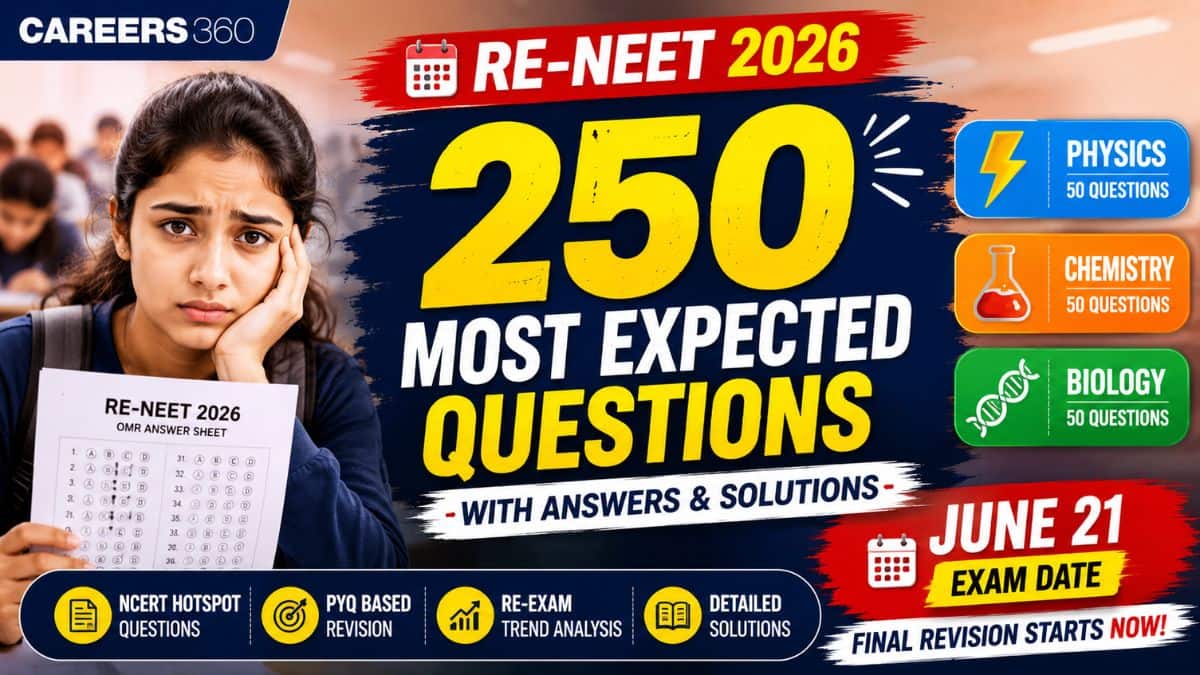
These questions cover the highest-weightage topics from Physics, Chemistry, and Biology, including concepts that have repeatedly appeared across NEET and re-examination papers. The complete PDF contains detailed solutions, while this article provides a free preview of important questions, expected chapter-wise trends, NCERT hotspots, and last-minute revision priorities for the June 21 examination.
250 high-priority practice questions across four downloadable PDFs, including one combined 100-question revision PDF and three subject-wise PDFs containing 50 questions each for Physics, Chemistry and Biology.
| Particular | Details |
|---|---|
| Total Questions Available | 250 |
| Combined Re-NEET PDF | 100 Questions |
| Physics PDF | 50 Questions |
| Chemistry PDF | 50 Questions |
| Biology PDF | 50 Questions |
| Solutions | Included |
| Based On | NCERT + PYQs + Re-Exam Trends |
| Difficulty Level | Moderate to Difficult |
| PDF Download | Free |
Get expert advice on college selection, admission chances, and career path in a personalized counselling session.
With only a few days remaining before the Re-NEET 2026 examination on June 21, many aspirants are focusing on high-probability concepts rather than attempting entirely new chapters. Revising repeated NCERT concepts, previous-year trends, and frequently tested question patterns can help improve accuracy and confidence during the final phase of preparation. The re-examination is scheduled for June 21 in pen-and-paper mode.
Among all patterns observed in Re-AIPMT 2015 and Re-NEET 2024, the most surprising finding was the sharp increase in Physics numerical questions. In both re-examinations, numerical and formula-based questions gained weightage, while direct Biology and diagram-based questions reduced significantly.
|
Exam |
Physics Numericals |
|
NEET 2024 |
13 |
|
Re-NEET 2024 |
26 |
Physics numericals doubled in the Re-NEET 2024 paper. A similar increase was observed in Re-AIPMT 2015.
At the same time, diagram-based questions reduced sharply and Biology became more NCERT-direct.
This suggests that students preparing for Re-NEET 2026 should spend more time solving formula-based questions, statement-based NCERT questions and direct concept applications than relying only on diagram memorisation.
| Subject | Biggest Shift |
|---|---|
| Physics | Numericals doubled |
| Chemistry | Difficulty increased |
| Biology | More NCERT-direct |
| Diagrams | Reduced sharply |
900+ questions analysed
AIPMT 2015, Re-AIPMT 2015, Re-NEET 2024, NEET 2024 and NEET 2026 reviewed
250 questions shortlisted
30 free preview questions included
NCERT-based questions dominated previous re-exams
Analysis of previous re-examinations showed that Biology consistently shifted towards NCERT-direct and theory-dominant questions, while Chemistry became the most difficult subject and Physics showed a rise in numerical questions.
Chemistry became harder in both Re-AIPMT 2015 and Re-NEET 2024.
Physics numerical questions increased in both re-examinations.
Biology shifted towards more direct NCERT-based questions.
Diagram and graph-based questions reduced significantly in re-tests.
Theory questions remained dominant across all re-examinations.
High-Value Re-NEET 2026 Study Resources for Maximum Score:
To prepare this question bank, Careers360 experts analysed question patterns from Re-AIPMT 2015, Re-NEET 2024, NEET 2024, NEET 2026 and previous-year NEET papers.
Selection criteria included:
Concepts repeated across multiple NEET examinations
NCERT lines frequently converted into direct questions
High-weightage chapters based on recent exam trends
Statement-based and assertion-reason questions
Frequently repeated Biology diagrams
Physics formula applications and numerical concepts
Organic Chemistry reaction patterns repeatedly tested in NEET
More than 900 questions were analysed before shortlisting the final 250 high-probability questions.
|
Trend |
Evidence |
|
Physics numericals increase |
+5 in Re-AIPMT 2015 and +12 in Re-NEET 2024 |
|
Chemistry becomes harder |
Easy questions dropped by 28–38 percentage points |
|
Biology becomes more NCERT-focused |
Higher proportion of direct NCERT questions |
|
Diagram questions reduce |
AIPMT diagrams dropped from 13 to 2 |
|
Theory remains dominant |
Largest question category across all exams |
These 250 questions were selected after studying recurring chapter patterns, question-type shifts, NCERT dependency trends and subject-wise difficulty changes observed across previous re-examinations. Particular attention was given to chapters that repeatedly gained weightage during re-tests, including Cell: The Unit of Life, Evolution, Biotechnology, Molecular Basis of Inheritance, Coordination Compounds and Current Electricity.
Students preparing for Re-NEET 2026 can download the most expected questions PDFs for Physics, Chemistry, and Biology from the table below. These PDFs are prepared based on previous year trends, high-weightage chapters, repeated concepts, and important NCERT topics likely to appear in the re-exam.
Access all 250 high-probability questions, chapter-wise solutions, repeated PYQ concepts, NCERT hotspots and expert-curated revision questions for the June 21 re-examination.
|
Expected Questions |
Download Link |
|
Re-NEET 2026 Most Expected Questions PDF |
No organisation can predict the exact questions that will appear in Re-NEET 2026. The questions included in this PDF are based on historical question trends, NCERT analysis, repeated PYQ concepts, chapter-wise weightage and previous re-examination patterns. Students should use these questions as a revision and practice resource rather than as a guarantee of exam content.
This PDF is useful for:
Check now:
The following 30 questions represent a free preview of the complete Re-NEET 2026 Most Expected Questions PDF. These questions have been shortlisted from thousands of NEET and re-exam questions after analysing repeated concepts, chapter weightage, NCERT trends and recent examination patterns.
These questions were selected after analysing more than 900 questions from NEET 2024, Re-NEET 2024, Re-AIPMT 2015 and previous NEET papers. The final shortlist prioritises repeated concepts, NCERT-derived questions, high-weightage chapters, statement-based questions and concepts that gained importance during previous re-examinations.
Many of the concepts covered below have appeared multiple times in previous NEET examinations and remain among the strongest candidates for repetition in Re-NEET 2026.
These Re-NEET 2026 Physics questions are selected from the most repeated NEET concepts and high-weightage chapters like Current Electricity, Electrostatics, Ray Optics, and Semiconductor Electronics. Candidates can also download the complete PDF for chapter-wise practice and quick revision.
Q1. The ratio of distances travelled by a freely falling body during the 1st, 2nd, 3rd and 4th second is:
(1) $1:1:1:1$
(2) $1:2:3:4$
(3) $1:4:9:16$
(4) $1:3:5:7$
Correct Answer: (4)
Explanation:
Distance travelled in the $n^{\text{th}}$ second is given by:
$S_n = \frac{g}{2}(2n-1)$
Hence, the ratio is $1:3:5:7$.
Q2. If a soap bubble expands, its radius increases. The pressure inside the bubble:
(1) Becomes equal to atmospheric pressure
(2) Decreases
(3) Increases
(4) Remains the same
Correct Answer: (2)
Explanation:
Excess pressure inside a soap bubble is:
$P = \frac{4T}{r}$
As the radius $r$ increases, pressure decreases.
Q3. With increase in temperature, the electrical resistance:
(1) Decreases for conductors, increases for semiconductors
(2) Increases for both
(3) Decreases for both
(4) Increases for conductors, decreases for semiconductors
Correct Answer: (4)
Explanation:
Conductors have a positive temperature coefficient, while semiconductors have a negative temperature coefficient.
Q4. Plane angle and solid angle:
(1) Have both units and dimensions
(2) Have units but no dimensions
(3) Have dimensions but no units
(4) Have neither units nor dimensions
Correct Answer: (2)
Explanation:
Plane angle and solid angle are dimensionless quantities, but they are expressed in units of radian and steradian respectively.
Q5. In a half-wave rectifier, if the input frequency is $60,\text{Hz}$, the output frequency is:
(1) $120,\text{Hz}$
(2) $0,\text{Hz}$
(3) $30,\text{Hz}$
(4) $60,\text{Hz}$
Correct Answer: (4)
Explanation:
A half-wave rectifier produces one output pulse for every input cycle. Therefore, output frequency remains $60,\text{Hz}$.
Q6. Angle between electric field lines and an equipotential surface is:
(1) $0^\circ$
(2) $45^\circ$
(3) $90^\circ$
(4) $180^\circ$
Correct Answer: (3)
Explanation:
Electric field lines are always perpendicular to equipotential surfaces.
Q7. A shell initially at rest explodes into three fragments of masses in the ratio $2:2:1$. The two heavier fragments move perpendicular to each other with equal speed $v$. The speed of the lighter fragment is:
(1) $v$
(2) $\sqrt{2}v$
(3) $2\sqrt{2}v$
(4) $4v$
Correct Answer: (3)
Explanation:
Using conservation of momentum:
Resultant momentum of heavier fragments:
$p = \sqrt{(2mv)^2 + (2mv)^2}$
$p = 2mv\sqrt{2}$
For the lighter fragment of mass $m$:
$mv' = 2mv\sqrt{2}$
Therefore,
$v' = 2\sqrt{2}v$
Q8. A spherical ball is dropped in a long column of viscous liquid. The speed vs time graph is:
(1) Decreasing
(2) Increasing then constant
(3) Constant
(4) Linear increase
Correct Answer: (2)
Explanation:
Initially, velocity increases with time. After reaching terminal velocity, it becomes constant.
Q9. A long solenoid having $1000$ turns per metre carries a current of $1,\text{A}$. The magnetic field at the centre is:
(1) $6.28\times10^{-4},\text{T}$
(2) $6.28\times10^{-2},\text{T}$
(3) $12.56\times10^{-4},\text{T}$
(4) $12.56\times10^{-2},\text{T}$
Correct Answer: (3)
Explanation:
Magnetic field inside a solenoid:
$B = \mu_0 n I$
$= 4\pi\times10^{-7}\times1000\times1$
$= 12.56\times10^{-4},\text{T}$
Q10. Two conducting spheres have equal charge. The potential is:
(1) Same for both
(2) Larger sphere has higher potential
(3) Smaller sphere has higher potential
(4) Depends on material
Correct Answer: (3)
Explanation:
Potential of a charged sphere is:
$V = \frac{kQ}{R}$
Smaller radius implies higher potential.
|
|
|
|
|
|
Also Check: Re NEET Physics 2026 Sample Paper
Re-NEET 2026 Chemistry Most Expected Questions (With Answers & Solutions)
The following Chemistry questions for Re-NEET 2026 cover important NCERT-based concepts, Organic Chemistry reactions, and Physical Chemistry numericals frequently asked in NEET. Students can download the detailed PDF for more expected questions and exam-oriented preparation.
Q1. For an ideal solution, the correct option is:
(1) $\Delta_{\text{mix}} S = 0$ at constant $T$ and $P$
(2) $\Delta_{\text{mix}} V \neq 0$ at constant $T$ and $P$
(3) $\Delta_{\text{mix}} H = 0$ at constant $T$ and $P$
(4) $\Delta_{\text{mix}} G = 0$ at constant $T$ and $P$
Correct Answer: (3) $\Delta_{\text{mix}} H = 0$ at constant $T$ and $P$
Solution:
An ideal solution is one in which the enthalpy of mixing is zero.
$\Delta_{\text{mix}} H = 0$
The Gibbs free energy of mixing is always negative for spontaneous mixing, and volume change on mixing is also zero. Therefore, option (3) is correct.
Q2. For a given reaction, $\Delta H = 35.5,\text{kJ mol}^{-1}$ and $\Delta S = 83.6,\text{J K}^{-1}\text{mol}^{-1}$. The reaction is spontaneous at:
(Assume that $\Delta H$ and $\Delta S$ do not vary with temperature.)
(1) $T > 425,\text{K}$
(2) All temperatures
(3) $T > 298,\text{K}$
(4) $T < 425,\text{K}$
Correct Answer: (1) $T > 425,\text{K}$
Solution:
For a spontaneous process:
$\Delta G < 0$
Using the Gibbs free energy equation:
$\Delta G = \Delta H - T\Delta S$
For spontaneity:
$\Delta H - T\Delta S < 0$
$T > \dfrac{\Delta H}{\Delta S}$
$T > \dfrac{35.5 \times 1000}{83.6}$
$T > 424.6,\text{K} \approx 425,\text{K}$
Hence, the reaction is spontaneous when:
$T > 425,\text{K}$
Q3. The rate constant for a first-order reaction is $4.606 \times 10^{-3},\text{s}^{-1}$. The time required to reduce $2,\text{g}$ of the reactant to $0.2,\text{g}$ is:
(1) $1000,\text{s}$
(2) $100,\text{s}$
(3) $200,\text{s}$
(4) $500,\text{s}$
Correct Answer: (4) $500,\text{s}$
Solution:
For a first-order reaction:
$kt = 2.303 \log \left(\dfrac{A_0}{A}\right)$
Substituting values:
$4.606 \times 10^{-3} \times t = 2.303 \log \left(\dfrac{2}{0.2}\right)$
$4.606 \times 10^{-3} \times t = 2.303 \log 10$
$4.606 \times 10^{-3} \times t = 2.303$
$t = \dfrac{2.303}{4.606 \times 10^{-3}}$
$t = 500,\text{s}$
Q4. If the rate constant for a first-order reaction is $k$, the time $(t)$ required for completion of $99%$ of the reaction is given by:
(1) $t = \dfrac{0.693}{k}$
(2) $t = \dfrac{6.909}{k}$
(3) $t = \dfrac{4.606}{k}$
(4) $t = \dfrac{2.303}{k}$
Correct Answer: (3) $t = \dfrac{4.606}{k}$
Solution:
For a first-order reaction:
$t = \dfrac{2.303}{k} \log \left(\dfrac{100}{100-99}\right)$
$t = \dfrac{2.303}{k} \log 100$
Since:
$\log 100 = 2$
Therefore:
$t = \dfrac{2.303 \times 2}{k}$
$t = \dfrac{4.606}{k}$
Q5. Which of the following diatomic molecular species has only $\pi$-bonds according to Molecular Orbital Theory?
(1) $O_2$
(2) $N_2$
(3) $C_2$
(4) $Be_2$
Correct Answer: (3) $C_2$
Solution:
The molecular orbital configuration of $C_2$ is:
$(\sigma 1s)^2(\sigma^{}1s)^2(\sigma 2s)^2(\sigma^{}2s)^2(\pi 2p_x)^2(\pi 2p_y)^2$
The bonding electrons are present only in $\pi$ molecular orbitals. Hence, $C_2$ contains only $\pi$-bonds.
Q6. Consider the following species: $CN^+$, $CN^-$, $NO$, and $CN$. Which one of these has the highest bond order?
(1) $CN^+$
(2) $CN^-$
(3) $NO$
(4) $CN$
Correct Answer: (2) $CN^-$
Solution:
Bond order is calculated using:
$\text{Bond Order} = \dfrac{N_b - N_a}{2}$
$NO$ has $15$ electrons $\Rightarrow$ Bond order $= 2.5$
$CN^-$ has $14$ electrons $\Rightarrow$ Bond order $= 3$
$CN^+$ has $12$ electrons $\Rightarrow$ Bond order $= 2$
$CN$ has $13$ electrons $\Rightarrow$ Bond order $= 2.5$
Hence, $CN^-$ has the highest bond order.
Q7. The pH of a saturated solution of $Ca(OH)2$ is $9$. The solubility product $(K{sp})$ of $Ca(OH)_2$ is:
(1) $0.5 \times 10^{-15}$
(2) $0.25 \times 10^{-10}$
(3) $0.125 \times 10^{-15}$
(4) $0.5 \times 10^{-10}$
Correct Answer: (1) $0.5 \times 10^{-15}$
Solution:
Given:
$pH = 9$
Therefore:
$pOH = 14 - 9 = 5$
$[OH^-] = 10^{-5}$
For:
$Ca(OH)_2 \rightarrow Ca^{2+} + 2OH^-$
$[Ca^{2+}] = \dfrac{10^{-5}}{2}$
Now:
$K_{sp} = [Ca^{2+}][OH^-]^2$
$= \left(\dfrac{10^{-5}}{2}\right)(10^{-5})^2$
$= 0.5 \times 10^{-15}$
Q8. The solubility of $BaSO_4$ in water is $2.42 \times 10^{-3},\text{g L}^{-1}$ at $298,\text{K}$. The value of its solubility product $(K_{sp})$ is:
(Given molar mass of $BaSO_4 = 233,\text{g mol}^{-1}$)
(1) $1.08 \times 10^{-14},\text{mol}^2\text{L}^{-2}$
(2) $1.08 \times 10^{-12},\text{mol}^2\text{L}^{-2}$
(3) $1.08 \times 10^{-10},\text{mol}^2\text{L}^{-2}$
(4) $1.08 \times 10^{-8},\text{mol}^2\text{L}^{-2}$
Correct Answer: (3) $1.08 \times 10^{-10},\text{mol}^2\text{L}^{-2}$
Solution:
Molar solubility:
$s = \dfrac{2.42 \times 10^{-3}}{233}$
$s = 1.038 \times 10^{-5},\text{mol L}^{-1}$
For:
$BaSO_4 \rightleftharpoons Ba^{2+} + SO_4^{2-}$
$K_{sp} = s^2$
$= (1.038 \times 10^{-5})^2$
$= 1.08 \times 10^{-10},\text{mol}^2\text{L}^{-2}$
Q9. Which one of the following elements is unable to form $MF_6^{3-}$ ion?
(1) $B$
(2) $Al$
(3) $Ga$
(4) $In$
Correct Answer: (1) $B$
Solution:
Boron belongs to the second period and does not possess vacant $d$-orbitals. Therefore, it cannot expand its coordination number beyond $4$ and cannot form $BF_6^{3-}$.
Q10. The correct order of atomic radii in group 13 elements is:
(1) $B < Ga < Al < Tl < In$
(2) $B < Al < Ga < In < Tl$
(3) $B < Al < In < Ga < Tl$
(4) $B < Ga < Al < In < Tl$
Correct Answer: (4) $B < Ga < Al < In < Tl$
Solution:
In group 13, the order of atomic radii is irregular due to transition contraction. The discontinuity between $Al$ and $Ga$ arises because $d$ and $f$ electrons show poor shielding effect.
Hence, the correct order is:
$B < Ga < Al < In < Tl$
Re-NEET 2026 Biology Most Expected Questions (With Answers & Solutions)
The following Re-NEET 2026 Biology questions are prepared based on NCERT trends, previous year papers, and high-weightage chapters such as Genetics, Biotechnology, Human Physiology, and Ecology. Students can also download the complete PDF for additional practice and revision.
Q1. Which of the following is the correct unit of productivity in an ecosystem?
(1) $\text{KCal m}^{-2}\text{yr}^{-1}$
(2) $\text{g m}^{-2}$
(3) $\text{KCal m}^{-2}$
(4) $\text{KCal m}^{-3}$
Correct Answer: (1) $\text{KCal m}^{-2}\text{yr}^{-1}$
Explanation:
Productivity is measured as the rate of energy production per unit area per unit time. Therefore, its unit is:
$\text{KCal m}^{-2}\text{yr}^{-1}$
Q2. The first occurrence of menstruation in females is known as:
(1) Ovulation
(2) Menopause
(3) Menarche
(4) Diapause
Correct Answer: (3) Menarche
Explanation:
Menarche marks the beginning of the menstrual cycle in females and indicates reproductive maturity.
Q3. Genes $R$ and $Y$ assort independently. If $RRYY$ produces round yellow seeds and $rryy$ produces wrinkled green seeds, what is the phenotypic ratio in the $F_2$ generation?
(1) $9:7$
(2) $1:2:1$
(3) $3:1$
(4) $9:3:3:1$
Correct Answer: (4) $9:3:3:1$
Explanation:
This is a classic dihybrid cross demonstrating Mendel’s law of independent assortment.
Phenotypic ratio in the $F_2$ generation:
$9:3:3:1$
Q4. What is the main function of spindle fibres during mitosis?
(1) Regulate cell growth
(2) Separate chromosomes
(3) Synthesise DNA
(4) Repair DNA
Correct Answer: (2) Separate chromosomes
Explanation:
Spindle fibres attach to centromeres and pull sister chromatids toward opposite poles during cell division.
Q5. How many meiotic and mitotic divisions are required to form a mature female gametophyte from a megaspore mother cell in angiosperms?
(1) No meiosis and $2$ mitosis
(2) $2$ meiosis and $3$ mitosis
(3) $1$ meiosis and $2$ mitosis
(4) $1$ meiosis and $3$ mitosis
Correct Answer: (4) $1$ meiosis and $3$ mitosis
Explanation:
One meiotic division produces four megaspores. One functional megaspore then undergoes three mitotic divisions to form the embryo sac.
Q6. Which of the following statements about antibody structure is NOT correct?
(1) Constant regions are at the C-terminal
(2) Two heavy and two light chains are present
(3) Chains are linked by disulfide bonds
(4) Antigen-binding site is at the C-terminal
Correct Answer: (4) Antigen-binding site is at the C-terminal
Explanation:
The antigen-binding site is located at the variable region near the N-terminal end, not at the C-terminal end.
Q7. Who proposed that the genetic code consists of triplet nucleotides?
(1) Franklin Stahl
(2) George Gamow
(3) Francis Crick
(4) Jacques Monod
Correct Answer: (2) George Gamow
Explanation:
George Gamow proposed that the genetic code is made up of triplet nucleotides called codons.
Q8. Which equation represents logistic population growth?
(1) $\dfrac{dN}{dt} = N\left(\dfrac{r-K}{K}\right)$
(2) $\dfrac{dN}{dt} = r\left(\dfrac{K-N}{K}\right)$
(3) $\dfrac{dN}{dt} = rN\left(\dfrac{K-N}{K}\right)$
(4) $\dfrac{dN}{dt} = rN\left(\dfrac{N-K}{N}\right)$
Correct Answer: (3)
Explanation:
The logistic growth equation is:
$\dfrac{dN}{dt} = rN\left(\dfrac{K-N}{K}\right)$
where:
$N$ = population size
$r$ = intrinsic rate of increase
$K$ = carrying capacity
Q9. Which hormone is released by the pituitary gland but synthesised in the hypothalamus?
(1) ACTH
(2) LH
(3) ADH
(4) FSH
Correct Answer: (3) ADH
Explanation:
ADH (Antidiuretic Hormone) is synthesised in the hypothalamus and stored and released by the posterior pituitary gland.
Q10. Inhibition of succinic dehydrogenase enzyme by malonate is a classical example of:
(1) Competitive inhibition
(2) Enzyme activation
(3) Cofactor inhibition
(4) Feedback inhibition
Correct Answer: (1) Competitive inhibition
Explanation:
Malonate structurally resembles succinate and competes for the active site of succinic dehydrogenase enzyme, thereby blocking substrate binding.
|
Chapter |
Re-Exam Signal |
|
Cell: The Unit of Life |
Increased in Re-AIPMT 2015 |
|
Evolution |
One of the largest increases in Re-NEET 2024 |
|
Biotechnology |
Repeated across multiple exam cycles |
|
Molecular Basis of Inheritance |
Consistently high frequency |
|
Animal Kingdom |
Appeared heavily in both NEET and re-exams |
|
Coordination Compounds |
Repeated Chemistry favourite |
|
Current Electricity |
Appeared in every analysed exam |
Current Electricity Numericals
Molecular Basis of Inheritance
Coordination Compounds
Biotechnology Processes
Electrostatics Applications
Historical analysis shows that medical entrance re-examinations often differ slightly from regular NEET papers. Re-exams generally contain a higher proportion of direct NCERT questions, statement-based questions, familiar PYQ concepts and straightforward application-based numericals.
This trend was visible in both Re-AIPMT 2015 and Re-NEET 2024, making previous re-exam papers an important resource for Re-NEET 2026 preparation.
Students should also read about the mistakes to avoid in NEET preparation and follow the latest NEET exam day guidelines to avoid unnecessary errors during the examination.
NCERT Biology diagrams
Genetics pedigree questions
Biotechnology tools
Human Physiology NCERT lines
Current Electricity formulas
Electrostatics concepts
Ray Optics numericals
Coordination Compounds
Chemical Kinetics
Biomolecules and Polymers
Frequently Asked Questions (FAQs)
The most important chapters for Re-NEET 2026 include Current Electricity, Coordination Compounds, Molecular Basis of Inheritance, Biotechnology, Hydrocarbons, Human Health and Disease, and Electrostatics. These chapters have shown consistently high weightage in the last five years of NEET papers.
Previous year questions are extremely important for Re-NEET 2026 because NEET often repeats concepts, question patterns, and NCERT-based themes. However, students should also revise high-weightage chapters, mock tests, and NCERT examples regularly.
In the final days before Re-NEET 2026, students should focus mainly on NCERT revision, formulas, short notes, and mock test analysis. Avoid starting new topics and prioritise high-weightage chapters from Physics, Chemistry, and Biology.
Analysis of previous re-examinations shows that numerical questions generally increase, especially in Physics, while diagram-based and graph-based questions tend to decrease. Theory-based and NCERT-direct questions continue to form a major portion of the paper.

On Question asked by student community
Hello Suma,
Here are the links you asked for. I hope they serve your purpose.
Hello Bhanuday,
Here are the links you requested. I hope you find them helpful.
Hello Savi
Please check the link below:
Hope it helps.
Hello, for AP NEET PG Category C seats, NRI documents are generally required if you are applying under the NRI quota, and eligibility depends on the applicable counselling rules. The fee payment currency and procedure should be confirmed from the current Dr. NTRUHS notification at its official website drntr.uhsap.in.
Hello, the NEET PG stipend at Parul University depends on the postgraduate course, academic year and applicable university policies.
the product 'P' will be ,


| Column A | Column B |
| A |
a) Organisation of cellular contents and further cell growth. |
| B |
b) Leads to formation of two daughter cells. |
| C |
c) Cell grows physically and increase volume proteins,organells. |
| D |
d) synthesis and replication of DNA. |
Match the correct option as per the process shown in the
0.16 g of dibasic acid required 25 ml of decinormal solution for complete neutralisation. The modecular weight of the acid will be
32
64
128
256
0xone is

Ranked #19 by NIRF, NAAC A++ Accredited | Recognized by dental council of India
Ranked among the top Dental Colleges for 7 consecutive years by India Today poll