
Search Colleges, Exams, Schools & more


Login
NEET PG 2025 Counselling: ‘Poor’ Medical Aspirants Paying Crores?
The entire thought process for introducing the Economically Weaker Section (EWS) category was to ensure that premium education was accessible to those who could not afford it. However, in the latest NEET PG Counselling outcomes, there have been certain admissions that paint a very different picture of the whole process.
This Story also Contains
- Who Is Considered EWS?
- The Numbers Behind the Contradiction
- EWS Candidates Allotted Seats in Deemed Universities
- What Does It Mean?
- When ‘Poverty’ Becomes a Privilege
- Conclusion
.jpg)
There have been EWS candidates who have been allotted seats in medical colleges where the fees are touching Rs. 2.8 crores for a single seat. Several admissions have exceeded Rs. 1 crores.
For a category that was introduced for families that earn less than Rs. 8 lakhs a year, the difference between the policy intent and reality is quite different and unsettling.
Who Is Considered EWS?
The eligibility criteria for a candidate to be considered in the EWS category are:
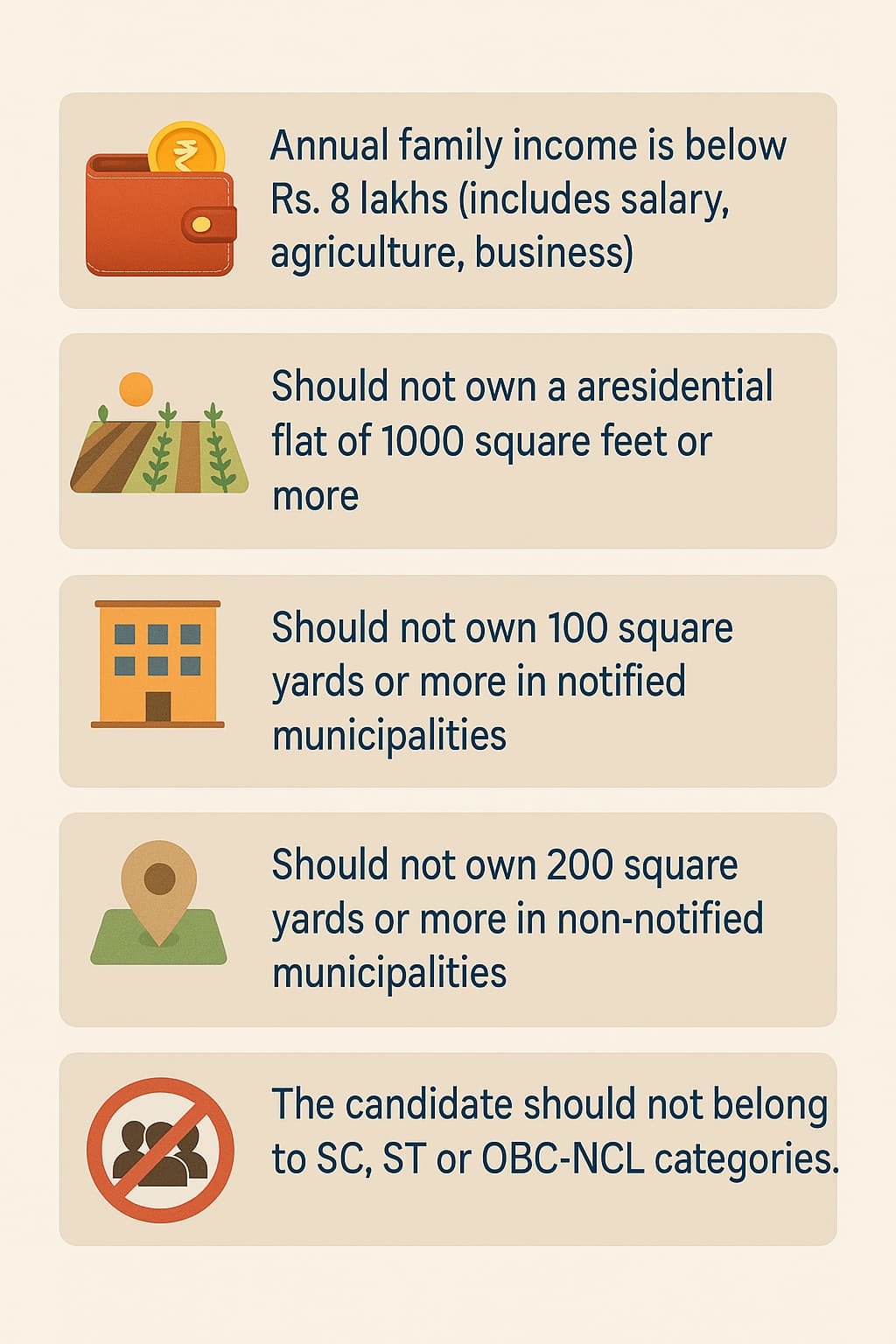
The eligibility criteria is meant to filter out candidates from well-off households and provide an opportunity to the genuinely underprivileged students. However, the NEET PG data suggest that in practice, the policy is failing!
Confused About College Admissions?
Get expert advice on college selection, admission chances, and career path in a personalized counselling session.
Book a Counselling Slot
Select Date
Pick a Slot
The Numbers Behind the Contradiction
The motive behind the EWS quota is to make higher education affordable and accessible for students who come from underprivileged backgrounds. However, the NEET PG Admission Data clearly shows that there is wealth behind a poverty certificate. There is a troubling issue at hand: students who are officially classified as ‘economically weak’, are being allotted seats in medical colleges where the fee is in crores.
147 EWS candidates were allotted seats in deemed universities, out of which
1 student received a seat with a fee above Rs. 2 crore
76 students were allotted seats costing above Rs. 1crore
137 students were allotted seats costing above Rs. 50 lakhs
146 students were allotted seats costing above Rs. 10 lakhs
1 student received a seat with a fee above Rs. 10 lakhs
EWS Candidates Allotted Seats in Deemed Universities
The table below reveals an extreme mismatch between the EWS eligibility and affordability. Although these candidates are considered ‘Economically Weak’, they have secured PG seats in medical colleges where the fee range is between Rs. 1.5 crores to Rs. 2.28 crores; an amount that is far beyond the economic capability of a low-income household.
Rank | Allotted Institute | Course | Course Fee |
47428 | Santosh Medical College and Hospital, Ghaziabad, Uttar Pradesh | M.D. (Radio- Diagnosis) | Rs. 2.28 Cr |
91992 | M.S. (Orthopaedics) | Rs. 1.87 Cr | |
50139 | M.D. (Obst. And Gynae)/Ms (Obstetrics And Gynaecology) | Rs. 1.80 Cr | |
73098 | Sri Siddhartha Medical College, Tumkur, Karnataka | M.D. (Paediatrics) | Rs. 1.80 Cr |
82200 | Dr. D. Y. Patil Medical College, Hospital and Research Centre, Pimpri, Pune, Maharashtra | M.S. (Orthopaedics) | Rs. 1.65 Cr |
52130 | Shri Sathya Sai Medical College and Research Institute, Chennai, Tamil Nadu | M.D. (Radio- Diagnosis) | Rs. 1.65 Cr |
90824 | Mahatma Gandhi Medical College and Research Institute, Pondicherry | M.S. (Orthopaedics) | Rs.1.5 Cr |
73533 | Rajarajeswari Medical College and Hospital, Bengaluru, Karnataka | M.S. (Orthopaedics) | Rs. 1.5 Cr |
48635 | Santosh Medical College and Hospital, Ghaziabad, Uttar Pradesh | M.D. (General Medicine) | Rs. 1.5 Cr |
55666 | Santosh Medical College and Hospital, Ghaziabad, Uttar Pradesh | M.D. (Obst. And Gynae)/Ms (Obstetrics And Gynaecology) | Rs. 1.5 Cr |
Observation: If we analyse the table, we can clearly see that EWS candidates with low ranks are being allotted medical seats that are costing anything between Rs. 1.5 crores to Rs. 2.38 crores. This signifies not only a gross misuse of the EWS certificates but also a poor EWS verification process.
What Does It Mean?
EWS reservation was meant to provide equal opportunities to the underprivileged, but NEET Medical PG admission data shows it is failing to achieve its intended purpose. A genuinely poor student does not get the seat; instead, a student who is ‘poor on paper’ gets the seat and pays the high fee (in this case, crores of rupees) for admission.
When ‘Poverty’ Becomes a Privilege
The issue is not about rich students entering medical education; it is the fact that they enter as poor students. The EWS quota was meant to help, but instead, it seems it has further alienated the genuinely poor student by taking away the opportunity and the means to have a quality life.
Conclusion
NEET PG establishes the fact that there is a mismatch between what the EWS reservation intended and what the outcome is like. Seats that were supposed to be for the economically weak were filled by those who are paying the fee, which is in crores, exposing a flawed system of verification and enforcement. Unless there are stricter checks in balance and the transparency of the entire admission procedure, the EWS quota will continue to fail the very students it was created to support.
Articles
Related Stories
|
Upcoming Medicine Exams

Certifications By Top Providers
Explore Top Universities Across Globe
Popular Courses and Specializations
List of colleges accepting NEET PG
Browse Medicine Colleges by State
Questions related to NEET PG
On Question asked by student community
Have a question related to NEET PG ?
Hello, the NEET PG stipend at Parul University depends on the postgraduate course, academic year and applicable university policies.
Hello Student,
If you are looking for information about NEET PG 2025 DNB seat allotment and the fees payable at the allotted college or hospital, DNB seats are allotted through the respective counselling process based on your rank, category, choice of speciality, and seat availability.
For the 2025 session, the
Dear Student, with a NEET PG 2026 rank of 6,600 in the EWS category, your options should be assessed using the relevant counselling year's college-wise closing ranks, category-wise seats and counselling round. Please also confirm whether you are applying through the applicable All India counselling route or another quota. That
Hello, with a NEET PG rank of 11,000, your chances of getting MS ENT at Government Medical College, Thiruvananthapuram depend on your category, state quota, counselling round and previous year’s closing rank. You can check the cutoff details here: https://medicine.careers360.com/articles/kerala-neet-pg-cut-off
Dear Student, with a NEET PG rank of 8,571, you can explore DNB Pediatrics options through the relevant counselling process. If Bangalore is your preferred location, it would be useful to compare the available hospitals on factors such as patient load, paediatric case exposure, teaching environment, stipend, bond conditions and

Study Resources, Applications and Opportunities
NEET PG All India & State College Predictor with Admission Process Guide
NEET PG Counseling Guidance
EnquireEnd-to-End NEET PG Admission Guidance | One-to-One Counselling | College Predictors | Regular Updates | E-books
NEET PG Notifications
Never miss NEET PG update
Get timely NEET PG updates directly to your inbox. Stay informed!